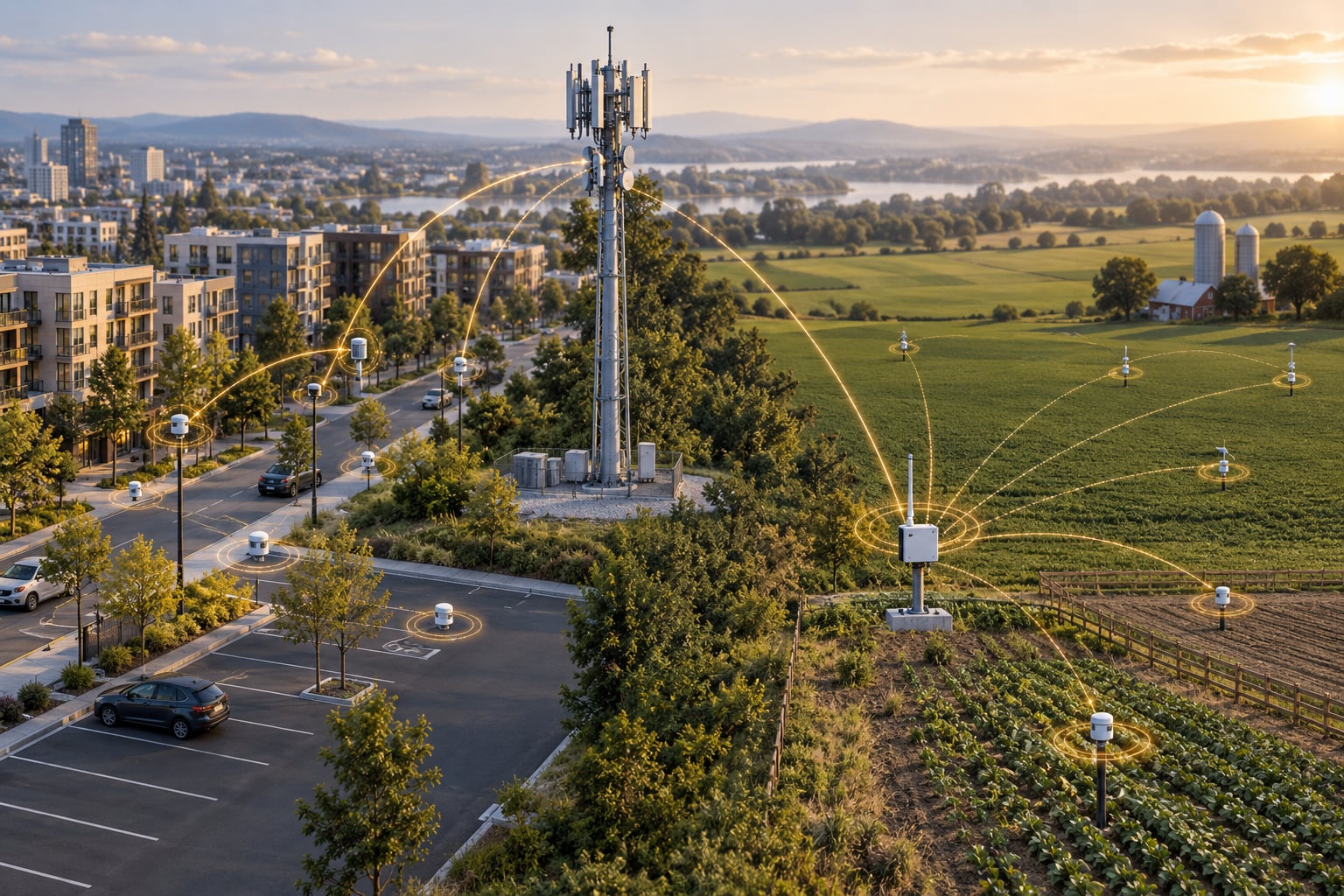
NB-IoT and LoRaWAN both send tiny amounts of data across long distances on tiny batteries, so they look interchangeable on paper. They are not: NB-IoT rides licensed mobile-network spectrum through existing cell towers managed by a carrier, while LoRaWAN runs on free unlicensed radio bands through gateways you can own and site yourself.
That single architectural split drives everything else you care about: coverage you did not build versus coverage you control, a monthly subscription versus hardware you maintain yourself, carrier-managed mobility versus stationary endpoints.
To be precise about how nb iot differs from lorawan in practice: pick NB-IoT when you need coverage in places you cannot install a gateway, when devices move between sites, or when you want someone else to run the radio network. Pick LoRaWAN when you want a private network you own, when reporting intervals are long and predictable, and when per-device recurring cost matters at scale.
Neither one replaces broadband cellular or Wi-Fi. Both are narrow-purpose tools for low-power wide-area work, and forcing video, OTA firmware blobs or high-frequency telemetry onto them is where projects go wrong.
Table of Contents
- How NB-IoT Differs from LoRaWAN at a Glance
- NB-IoT vs LoRaWAN: Network Architecture
- Where the data physically goes
- Three LoRaWAN operating modes
- Power Consumption and Battery Life
- Where the energy actually goes
- Coverage, Range, and Deployment Control
- Regional frequency bands you will actually meet
- Data Rate and IoT Application Fit
- Where each one fits naturally
- Cost, Ownership, and Operational Complexity
- Which Should You Choose?
- How NB-IoT Differs from LoRaWAN in day-to-day operations
- Frequently Asked Questions
- What are the key differences between LoRaWAN and NB-IoT?
- What does NB-IoT stand for?
- Is LoRaWAN obsolete?
- What are the disadvantages of LoRaWAN?
- Can LoRaWAN and NB-IoT work together in one deployment?
- Is NB-IoT better than LTE-M?
- Conclusion
How NB-IoT Differs from LoRaWAN at a Glance
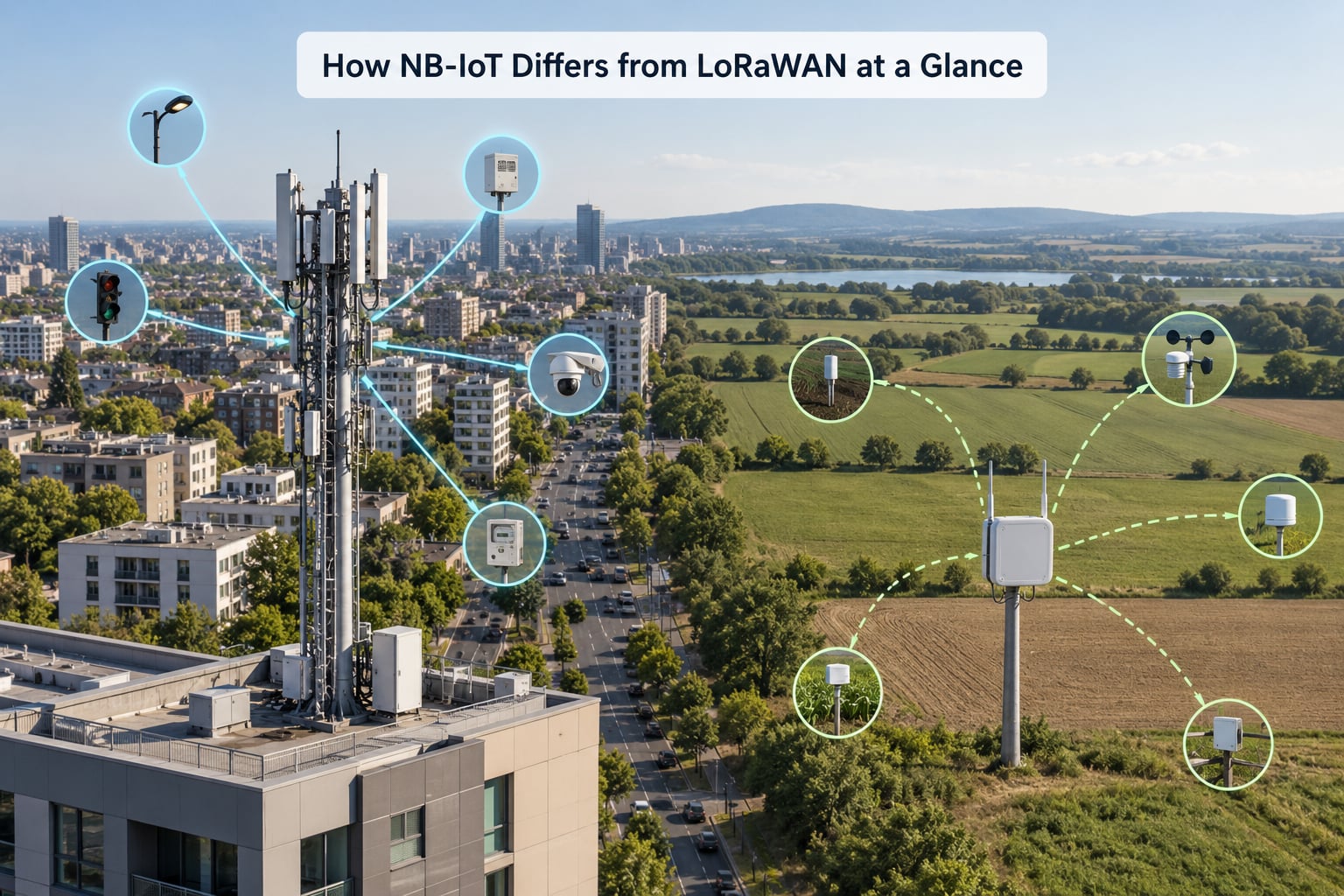
This table is the short version. Every row below expands in its own section further down.
| Criterion | NB-IoT | LoRaWAN |
|---|---|---|
| Spectrum | Licensed, carrier-owned | Unlicensed ISM bands |
| Typical frequency | 800 MHz US, 700 MHz Asia, 900/1800 MHz Europe and China | 868 MHz Europe, 915 MHz US, 923 MHz Asia-Pacific |
| Who runs it | Mobile network operator | You, an operator, or a community network |
| Network path | Device to base station to carrier core to IoT platform | End device to gateway to network server to application server |
| Identity | SIM or eSIM per device | Root keys burned into the module |
| Typical device range | Cell coverage, roughly 1 km urban to 10+ km rural | Roughly 1 km urban to 15 km rural from a gateway |
| Data rate | Low, tens of kbps or below in practice | 0.3 to 50 kbps depending on spread factor |
| Application payload | Bytes to low kilobytes | 51 bytes in Europe, up to 242 bytes US at low spread factors |
| Battery life | Up to about 10 years with PSM/eDRX | Often 5 to 10 years on small coin cells |
| Mobility | Supported, handover between towers | Designed for stationary devices |
| Latency | Seconds, longer with deep sleep cycles | Seconds for downlink, network-dependent |
| Encryption | 3GPP cellular security with SIM-based authentication | AES-128 end-to-end, keys in hardware module |
| Cost shape | Per-device subscription plus connectivity fee | Gateway CAPEX, backhaul, maintenance, no per-device fee |
One more difference deserves emphasis before the details: predictability. LoRaWAN capacity is a shared airwaves resource that you design for. NB-IoT capacity is purchased from a carrier in a coverage area that already has subscribers, so your worst-case performance depends on neighbours you never meet.
NB-IoT vs LoRaWAN: Network Architecture
NB-IoT is a 3GPP cellular standard, so a device behaves like a stripped-down phone. It attaches to the nearest cell tower using a SIM or eSIM, registers with the carrier’s core network, and gets an IP address. From there traffic moves to the carrier’s packet data gateway and on to your IoT platform over an APN or VPN.
Because the carrier already owns licensed spectrum, radio planning, backhaul and the core, an NB-IoT deployment is almost entirely a software and device project. There is no radio network to build, and the SIM itself is the security boundary that authenticates the device to the network.
Where the data physically goes
LoRaWAN has no connection to any mobile network. A battery-powered end device transmits directly to any gateway in range, over a chirp-spread-spectrum modulation in a sub-GHz ISM band. All gateways feed one network server, which de-duplicates the uplinks it heard, and the network server forwards each message to your application server, which decides what it means.
That ALOHA-style uplink is the reason LoRaWAN is so cheap per device, and also the reason it degrades under load. Every device transmits whenever it wants, so two devices talking at once collide and both are lost. Capacity planning is your job, not the network’s.
Three LoRaWAN operating modes
The operating mode you choose defines how much work falls on you:
- Private network: your gateways, your server, your radio plan. Full control, full responsibility.
- Public network: gateways run by an operator who sell you connectivity per device per year, similar in shape to an NB-IoT subscription.
- Community network: volunteer- or grant-funded infrastructure such as The Things Network. Useful for learning and prototyping, but coverage has gaps and there is no service-level commitment.
Power Consumption and Battery Life
LoRaWAN usually wins the battery-life argument at fixed, infrequent reporting. A device transmits a very short packet at a low spreading factor, then sleeps for minutes or hours doing almost nothing. Reported field figures commonly land between five and ten years on a coin cell or a lithium primary cell.
NB-IoT reaches similar lifespans using two mechanisms built into the LTE standard. Power Saving Mode (PSM) lets a device stay registered while its radio is off for long stretches, waking only to send. Extended Discontinuous Reception (eDRX) extends the paging window so the device does not have to check in so often.
Where NB-IoT costs you is activation energy. Attaching to a cell and completing registration costs real milliamp-hours, and a device that moves or that wakes frequently pays some of that repeatedly. For a meter that reports four times a day from the same basement, that overhead is irrelevant. For a device re-registering on every tower change, it is the dominant power term.
Where the energy actually goes
Both technologies are dominated by transmit energy, not processing. Three variables move the number far more than the protocol label does:
- Reporting frequency: ten messages a day is a different design problem from one per hour, on either network.
- Spreading factor and bandwidth: LoRaWAN trades airtime against link budget, so distant devices burn more current per message. NB-IoT trades bandwidth against sensitivity, so distant devices wait longer and stay awake longer.
- Re-registration behaviour: poor signal, battery voltage sag and network changes all force reconnect attempts that quietly burn budget.
For field devices, radio link margin is what people forget. A meter in a pit or a valve buried in the ground can consume its whole battery trying to transmit, and that happens on both networks.
Coverage, Range, and Deployment Control
Range numbers quoted for LoRaWAN are gateway-to-device distances under good conditions. In practice you get about a kilometre in dense urban clutter, several kilometres in open countryside, and considerably less inside a concrete basement. Deployments reported on smart city forums show coverage gaps of around five percent when LoRaWAN is the only layer, which is exactly why those projects add a second network.
NB-IoT coverage is whatever the carrier sells. Lower-band spectrum in the 700 to 900 MHz range penetrates concrete and soil better than the 2.4 GHz Wi-Fi and Bluetooth radios people often compare it against, so basement meter rooms, underground parking and pits are its strongest suit.
The trade is ownership. Carrier coverage is someone else’s asset, maintained and upgraded on someone else’s schedule, and it can change with your contract and your region. A private LoRaWAN network is a thing you survey, mount, backhaul and keep alive, and you can put a gateway exactly where your data comes from.
Regional frequency bands you will actually meet
If your devices cross a border, the band plan matters more than most people expect:
- Europe: LoRaWAN uses 868 MHz with a duty-cycle cap that is usually 1 percent overall for sub-GHz operation. NB-IoT is deployed around 900 MHz and 1800 MHz.
- United States: LoRaWAN uses 915 MHz with 8 uplink channels and a 2 second dwell time. NB-IoT is concentrated on 800 MHz.
- Asia-Pacific: LoRaWAN splits across 923 MHz with several country-specific channel masks. NB-IoT commonly runs at 700 MHz, with 1800 MHz in China.
That fragmentation is a real argument for NB-IoT in cross-border fleets, because one SIM profile can roam where an operator agreement exists.
Data Rate and IoT Application Fit
LoRaWAN moves small payloads at deliberately slow rates. The theoretical ceiling is around 50 kbps, but real deployments settle between roughly 0.3 and 5 kbps, with the payload cap set at 51 bytes in Europe and up to 242 bytes in the US at lower spread factors. That is enough for a meter reading, a door event or a heartbeat.
NB-IoT is also slow, usually tens of kbps, but the payload allowance is far more forgiving and the network is built around acknowledged delivery and queueing. Devices that send more often, or that must know their message arrived, cope better than they would on LoRaWAN.
Neither is a good fit for anything bandwidth-hungry. The classic mistakes are OTA firmware updates, camera snapshots and audio, and firmware delivery over NB-IoT in particular is slow because of the low rate plus the sleep cycles. If your design needs a 500 KB firmware push, plan for it separately or pick a different link.
Where each one fits naturally
NB-IoT suits fixed utility meters in hard-to-reach spots, water and gas meters underground, parking sensors attached to a carrier network, street lighting, waste bins on municipal contracts, and any sensor that moves between sites.
LoRaWAN suits farm clusters around barns and greenhouses, warehouse and campus monitoring, indoor building sensors, private industrial condition monitoring, and large fleets of static devices where you would rather not carry a connectivity contract per unit.
Cost, Ownership, and Operational Complexity
NB-IoT moves the cost into operations. You buy modules, which are generally dearer than LoRa modules, plus the devices themselves, plus a connectivity subscription per device. In exchange you avoid gateway capital, tower siting, backhaul, and the ongoing replacement of field hardware.
LoRaWAN moves the cost into capital. You buy gateways, mount them, provide power and either a wired or cellular backhaul, run the network and application servers, and plan gateway replacement inside the hardware lifespan. Per-device recurring cost is close to zero on a private network, so the maths inverts somewhere in the high hundreds or low thousands of devices.
The hidden line item is people. A private LoRaWAN network needs someone to answer when a gateway loses backhaul at a remote site, and owners of such networks consistently underestimate that maintenance load. Carrier coverage hides that work inside an agreement.
Hybrid deployments, where a gateway covers the easy density and cellular backs up the pits and the edges, are increasingly common precisely because neither network covers every awkward site on its own.
Which Should You Choose?
Use these five checks in order. Most teams can answer them in a meeting rather than a lab.
- Where are the devices? Fixed and clustered on a site you control points to LoRaWAN. Scattered across a city, a country or a moving fleet points to NB-IoT.
- What is the message? Occasional small readings point to LoRaWAN. Frequent, acknowledged, or queued data points to NB-IoT.
- How long is the deployment? Both run 10 years. Note that old 2G-based IoT networks are being switched off, and that affects migrations more than either technology.
- Who maintains radios? If you have no field crew, NB-IoT wins. If you already maintain outdoor sites, a private LoRaWAN network is cheaper per device over time.
- Does it have to move? Roaming between towers only exists on NB-IoT. LoRaWAN endpoints are meant to stay put.
How NB-IoT Differs from LoRaWAN in day-to-day operations
After launch the difference becomes cultural. NB-IoT is a vendor relationship: bills, coverage maps, SIM lifecycle management and a carrier support desk. LoRaWAN is an engineering responsibility: capacity planning, airtime budgets, gateway uptime and firmware discipline across your own hardware.
Teams that underestimate LoRaWAN usually underestimate airtime and collisions. Teams that underestimate NB-IoT usually underestimate per-device subscription creep over five years. Budget for both before you pick.
Frequently Asked Questions
What are the key differences between LoRaWAN and NB-IoT?
The core difference is spectrum and ownership. NB-IoT runs on licensed mobile spectrum through carrier cell towers with a SIM per device, so someone else runs the radio network. LoRaWAN runs on unlicensed ISM bands through gateways you can own and site yourself, so you run the network. That split drives coverage, mobility, cost structure and control.
What does NB-IoT stand for?
NB-IoT stands for Narrowband Internet of Things. It is a 3GPP cellular standard for low-power wide-area devices that runs on licensed spectrum, using narrow channels and power-saving modes designed to let devices run for years on a battery.
Is LoRaWAN obsolete?
No. LoRaWAN is an actively maintained standard with a large installed base, broad module availability and long network lifetimes. Its main pressures are spectrum fragmentation across regions and the fact that switching carriers at scale is not practical, so treat hardware choices as long-term commitments rather than obsolescence risks.
What are the disadvantages of LoRaWAN?
Duty-cycle limits restrict how often devices can transmit, especially in Europe where sub-GHz operation is often capped near 1 percent. ALOHA-style uplinks collide in dense deployments, private networks need gateway capital and ongoing maintenance, and the radio must be planned by you because you share the airwaves with everyone nearby.
Can LoRaWAN and NB-IoT work together in one deployment?
Yes, and many projects do it. LoRaWAN covers the dense, well-sited areas and NB-IoT backs up the awkward spots such as pits, basements and remote fields. Both can feed the same IoT platform, with the device or a dual-radio module choosing per message which path to use.
Is NB-IoT better than LTE-M?
It depends on the job. NB-IoT is the choice for very small, infrequent messages and the longest battery life, typically under 10 kbps. LTE-M is faster, supports mobility and voice, and handles firmware updates better, so choose LTE-M when you need throughput or the device moves between towers regularly.
Conclusion
NB-IoT is cellular connectivity you rent; LoRaWAN is radio infrastructure you run. Choose NB-IoT for wide geographic spread, moving devices and low field-maintenance tolerance. Choose LoRaWAN for static, dense, site-controlled deployments where you want no recurring per-device fee and full control of the airwaves.
Before you commit, write down five things: where the devices sit, how often each one reports, how big each message is, who will maintain the radios over ten years, and whether the device has to move. Answer those honestly and the choice usually makes itself. If the answers straddle both columns, plan a hybrid from the start rather than retrofitting one later.