
Paratransit scheduling is how a transit agency collects trip requests from certified riders, sorts them into shared door-to-door runs, and assigns each rider a vehicle and driver with a pickup window instead of a fixed time. You submit the request, the system batches it with nearby trips, and a dispatcher reviews the plan before the day arrives. Understanding those steps is what turns a vague promise of “a ride sometime” into a trip you can actually catch.
Last reviewed in October 2026. Numeric rules below come from published transit agency policy, and those rules change — always confirm the booking window, cutoff and suspension rules with the agency that serves your address.
Table of Contents
- How Paratransit Scheduling Works at a Glance
- What Is Paratransit and Who Uses It?
- What Happens Before a Ride Is Scheduled?
- Certification is the gate
- What goes into the rider record
- How Does the Booking Process Work?
- How far ahead you can book, and how
- What Information Does a Reservation Need?
- How Does the System Match a Ride to a Vehicle?
- What the matching engine weighs
- Why you might get a different driver or a different time
- How Are Riders Assigned and Confirmed?
- How Does Day-of-Trip Scheduling Work?
- How Do Wheelchairs, Mobility Aids, and Assistance Affect a Trip?
- How Does Paratransit Scheduling Handle Changes and Cancellations?
- What Happens If a Ride Is Late or Missed?
- How Do Scheduling Systems Improve Reliability?
- Frequently Asked Questions
- Is paratransit only for medical appointments?
- How far in advance do I need to book a paratransit ride?
- Can someone else book a paratransit ride for me?
- Why was my ride scheduled at a time I did not ask for?
- How long does a paratransit trip take compared to a bus?
- Is there a paratransit mobile app that tracks the vehicle?
- Conclusion
How Paratransit Scheduling Works at a Glance
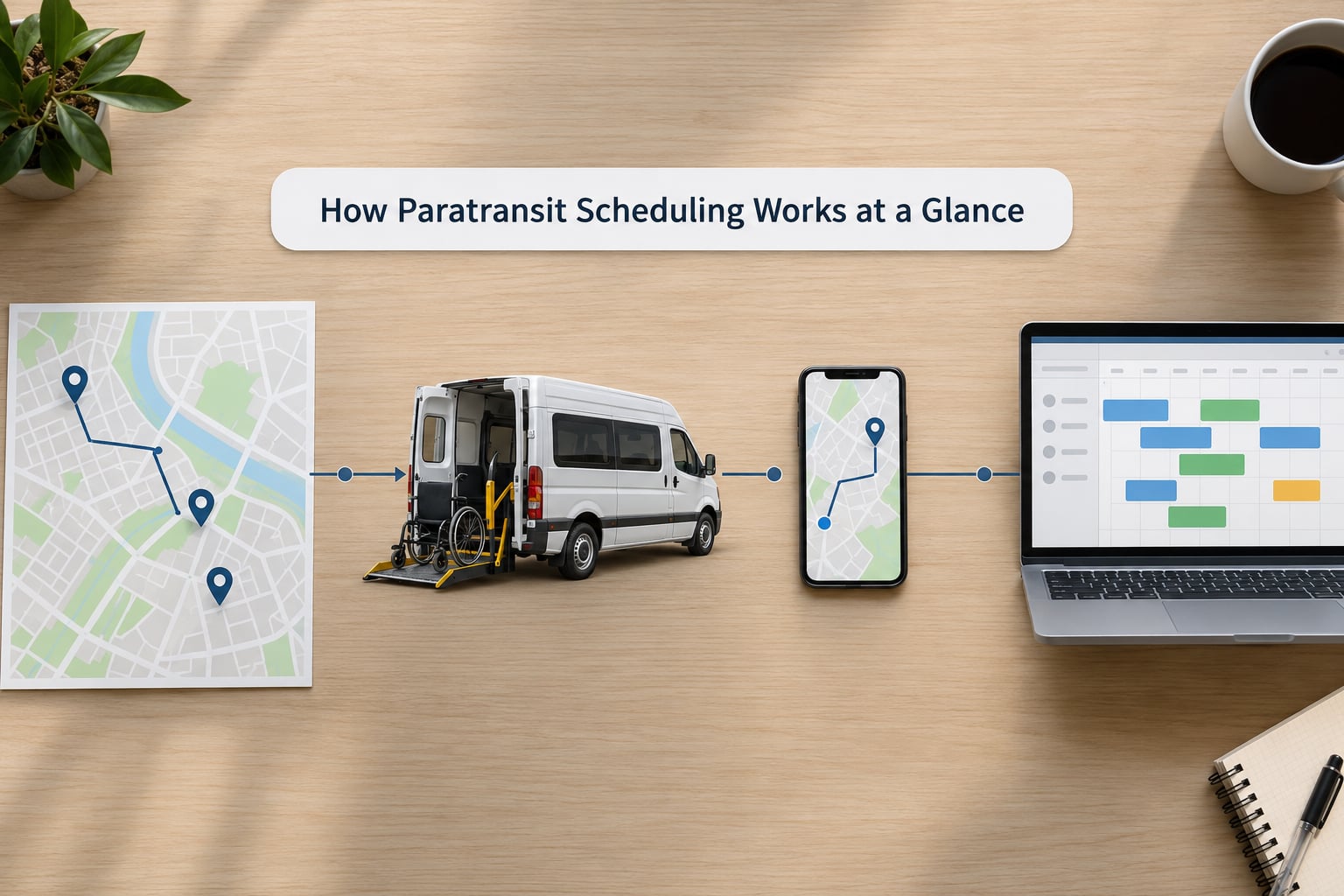
Here is the whole lifecycle in one pass: eligibility is certified, a reservation is filed, the request is matched to a vehicle, a pickup window is confirmed, the vehicle runs its manifest, and the trip closes out as boarded, cancelled, missed or denied. Each stage produces a record the next stage depends on.
| Stage | Information it uses | Main actor | What the rider gets |
|---|---|---|---|
| Eligibility certification | Functional assessment, mobility needs, service area | Agency certification staff | A certification that opens the account |
| Reservation | Date, requested time, address, purpose, passenger count, mobility device | Rider, caregiver or scheduler | A reference number and trip request |
| Batching and assignment | Pickup windows, vehicle type, seat and securement capacity, geography | Scheduling software with dispatcher review | A confirmed pickup window and vehicle class |
| Manifest generation | Assigned trips in sequence, run order, rider contacts | Dispatch system | A run sheet the driver works from |
| Day-of monitoring | Live vehicle location, traffic, late and early arrival flags | Dispatcher | Calls, app alerts or ETA text |
| Board and deliver | Boarding grace period, securement need, companion count | Driver | The trip itself, usually shared |
| Closeout | Boarded, no-show, missed, cancelled or denied outcome | Driver and agency records | A trip record that affects the next booking |
Nothing in that chain is autonomous. Software proposes; people decide.
What Is Paratransit and Who Uses It?
Paratransit is demand-responsive public transportation required under the Americans with Disabilities Act, generally described in federal rules at 49 CFR Part 37. Instead of a bus that follows a published route and timetable, a paratransit vehicle picks you up and drops you off, usually door-to-door.
It sits between two other things that riders routinely confuse with it. Fixed-route transit is the bus or train everyone else uses, running the same stops on a schedule. Medical transportation is non-emergency transport arranged through a health plan or insurer for a covered trip, usually with its own booking process and its own rules.
The people who use paratransit include riders with mobility disabilities, people who use mobility devices, older adults, people with cognitive or sensory disabilities, and anyone certified through the agency process. Caregivers and personal care attendants travel with many of them, and they are a scheduling party in their own right.
Why does scheduling need to be flexible? Because a fixed route assumes everyone boards and exits the same way at the same stop. Paratransit has to fit a wheelchair into a specific vehicle at a specific address, respect a specific appointment time, and still serve the next rider. Every one of those is a constraint the routing software has to satisfy.
What Happens Before a Ride Is Scheduled?
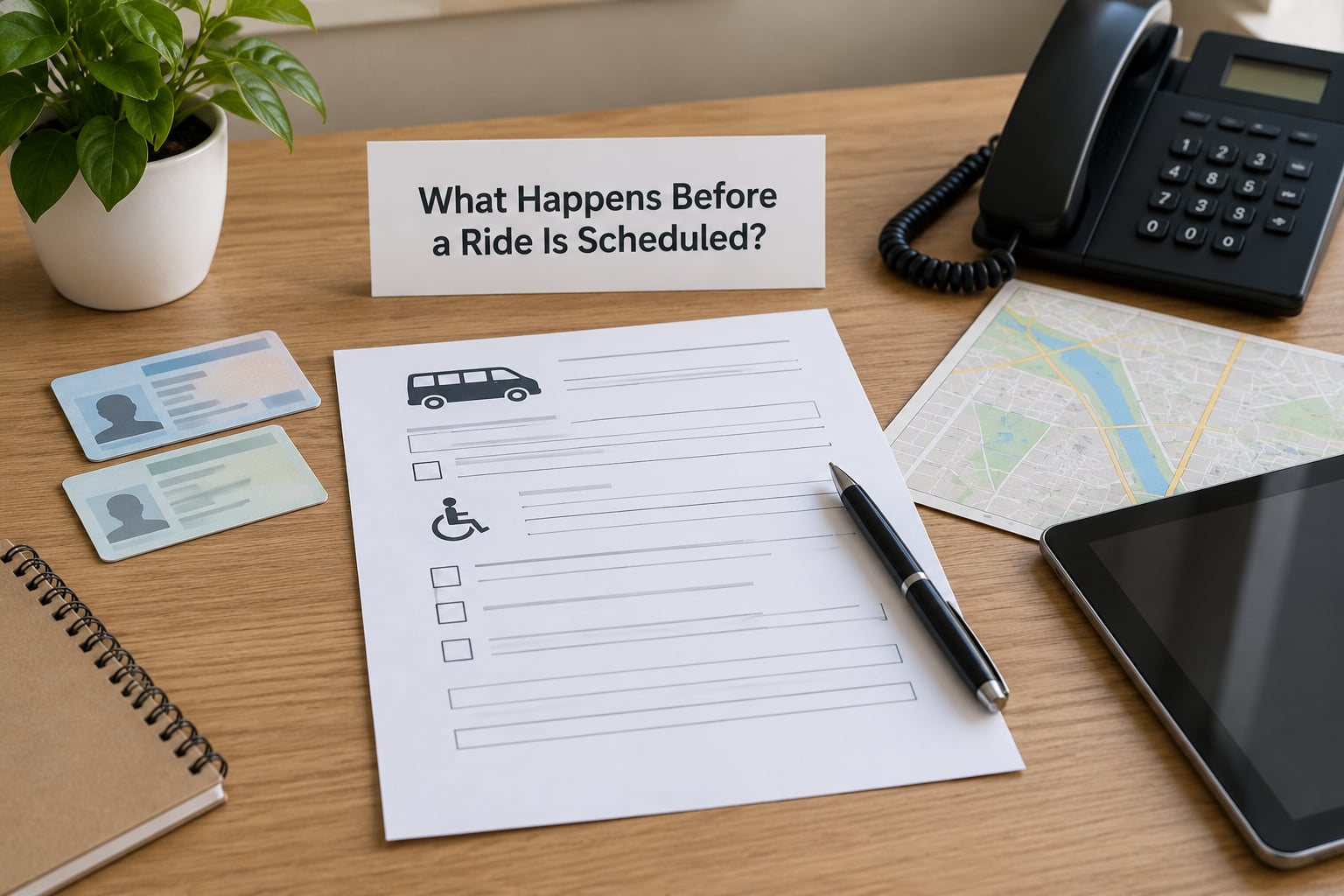
Certification is the gate
You cannot book a paratransit trip until the agency has certified you as eligible. Certification is based on whether the disability or condition prevents you from using the fixed-route service available in your area. Some agencies run the determination in person, some accept a clinician’s statement, and some ask for a functional assessment.
Certification is not permanent. Riders are recertified on a cycle, and the date matters more than most riders realize. Miss a recertification and the account can be suspended, which stops new reservations until it is sorted out.
What goes into the rider record
- Mobility aid: manual wheelchair, power wheelchair, scooter, walker, cane, or none
- Securement: whether a tie-down or occupant restraint is required
- Boarding help: whether you can transfer independently, need supervision, or are a stretcher or non-ambulatory case
- Capacity limits: weight, width and length of your mobility device, as measured at certification
- Accompanying riders: personal care attendant, companion, service animal, caregiver
- Communication: phone, text, email, relay or interpreter, and the best time to reach you
- Favourite addresses: home, regular day programs, recurring destinations
The service-area check happens here too. Paratransit is not unlimited — many agencies limit coverage to a corridor around fixed-route stops, and some require the trip to fall inside the agency’s service span and hours of operation. An address outside that area can be refused at scheduling rather than at pickup.
How Does the Booking Process Work?
Booking is the part riders interact with most, and it is much more structured than a quick app tap. A typical reservation walks through the same sequence: service model, date, requested time, pickup address, destination, number of passengers, mobility device, accompanying riders, and whether you want a return trip.
Two details trip up new riders. The first is negotiation: if the agency’s available window does not include the time you asked for, the scheduler may offer a nearby window instead. Many policies allow roughly an hour of flexibility around your requested time. If you reject the offered window, it is often recorded as a trip refusal rather than a missed trip, and refusals can factor into service decisions later.
The second is the return trip. Book both legs in advance, or you may be waiting for a phone call on the far side of the city when the return was never entered.
How far ahead you can book, and how
Numbers vary by agency. The figures below reflect published policy from several US transit authorities, offered as the typical pattern rather than a promise about your local service.
| Booking channel | Usual advance window | Typical cutoff | Same-day possible? |
|---|---|---|---|
| Phone call to the reservation line | 1 to 14 days ahead | Midday or late afternoon the day before | Sometimes, as a standby request |
| Interactive voice response (IVR) | 1 to 14 days ahead | Same as phone | Rarely |
| Web or mobile app | 1 to 14 days ahead | Often a few hours earlier than phone | Agency-dependent; improving |
| Caregiver or authorized third party | Same window as the rider | Same as above | Yes, if the account allows it |
| Subscription or recurring booking | Set once, repeats weekly | Locked far ahead, hard to change | Not applicable |
Subscription service is worth knowing about if your schedule barely changes — a weekly day program, a job shift, a recurring medical appointment. You register the pattern once and it runs without a new reservation each week. The trade-off is rigidity: subscription trips are usually locked in, which is why frequent schedule-changers get moved back to on-demand booking.
What Information Does a Reservation Need?
Essential fields are the ones without which the trip cannot be delivered: pickup date, requested time, exact pickup address with any access instructions, destination address, appointment time if it is time-critical, number of passengers, mobility device type, and whether a securement is needed.
Optional preferences shape comfort rather than feasibility: a specific driver if you have one, a favourite seat position, a preference for a particular ride group, or a note that you do not want to travel with a specific passenger. The agency records these and tries to honour them, but they lose to hard constraints like equipment availability and geography.
Identity verification exists for a practical reason — drivers need to know who they are picking up, especially when a caregiver is waiting at a different address. Certification usually handles this once, and later bookings are tied to that record.
On privacy, the people who can see your trip details usually include the agency’s call-taking and dispatch staff, the assigned driver, and any caregiver you have authorized. Riders have raised this concern repeatedly in disability and transit forums, so if a family member is managing your bookings, ask specifically which records they can see and whether you can remove that access later.
How Does the System Match a Ride to a Vehicle?
Assignment is a constraint problem, and the software solves it against everything it knows at that moment.
What the matching engine weighs
- Capacity — seats taken, space for the mobility device, securement positions, room for a personal care attendant
- Vehicle type — lift-equipped van, ramp bus, low-floor vehicle, or accessible taxi
- Geography — pickup and drop-off points that fit one run without a deadhead detour
- Time windows — a run can only take a rider if their pickup window and appointment time both still work
- Service restrictions — service area, hours of operation, trip length limits, vehicle capacity constraints
- Driver availability — shift span, qualifications, and time already committed to the run
Historical travel times matter more than map distance here. A routing algorithm that has watched the same corridor knows which intersections jam at 4 p.m., and it uses that learned pattern rather than the straight-line estimate a mapping app would give.
Why you might get a different driver or a different time
Efficiency and rider preference often point in opposite directions. The cheapest assignment fills the vehicle and shortens deadhead miles; your preference is the same familiar driver who knows your transfer routine. Agencies handle this with ride groups — a standing preference to keep certain riders together — that override the optimal assignment unless doing so would break on-time performance or service rules.
Automated scheduling supports dispatchers, it does not replace them. A dispatcher can reject an assignment, override a ride group, re-batch a run, or authorize a trip the software would not offer. Riders tell each other this matters, and they are right.
How Are Riders Assigned and Confirmed?
Confirmation is not the same as booking, and the gap between them causes most of the frustration riders describe online.
Once the reservation is accepted, the system may hold the trip as tentative while it waits for enough compatible trips to fill a run. A scheduler or dispatcher then reviews assignments, checks that the equipment and securement requirements match, and confirms. Some systems auto-confirm; larger agencies tend to have a human look before a trip goes to the driver.
A confirmed trip typically gives you a reference number, a pickup window with a ready time, the destination, the vehicle class, and how you will be notified. The pickup window is the key number on the whole document. A single scheduled minute does not exist in paratransit; a window does.
Changes arrive by the channel you named in your profile, and they can arrive late. If a driver calls in sick and the run needs rebuilding at 6 a.m., you may get a phone call rather than an app push. Riders who add text as a second channel report fewer surprises.
How Does Day-of-Trip Scheduling Work?
On the day, the run has an order. The manifest, sometimes called a run sheet, lists each trip in sequence with the passenger, address, mobility device, assistance needed, destination and contact details. The driver works top to bottom.
Dispatchers watch the vehicles in real time through automatic vehicle location data and traffic feeds. When something runs late, the dispatcher can warn waiting riders, re-sequence the remaining stops, or pull a trip off a vehicle and reassign it. That last option is why a confirmed trip can still change on the morning of travel.
Two timing rules matter most to riders. The ready time window says the vehicle may arrive any time inside a band, often around 30 minutes wide, rather than at one time. The boarding grace period is the short window after arrival during which the driver waits for you, commonly five minutes. Be ready with your device secured and your bags packed, because the wait is genuinely short.
If the vehicle arrives early or the rider is not ready, dispatch usually tries a phone call and can release the vehicle once the grace period ends. If the vehicle never arrives, that is a missed trip, and the escalation path differs from a rider-side no-show.
Standby and unscheduled requests are the same-day lane. When a vehicle finishes early and has room, leftover capacity goes to a standby list. Do not count on it, but if your agency offers it, it is worth requesting in the morning.
How Do Wheelchairs, Mobility Aids, and Assistance Affect a Trip?
Accessibility is not an add-on at boarding; it is a scheduling input from the start. Your device dimensions are stored in the rider record, and the system will not assign a vehicle whose lift, ramp or securement cannot take it.
Four points decide the match. Whether you board from a ramp or need to be lifted while seated, how many securement points the vehicle has and whether the tie-down type matches your chair, whether you can transfer to a seat independently or need driver assistance, and whether your device plus your attendant exceeds the vehicle’s capacity.
Power chairs need a charge plan on longer runs. Some agencies route specific vehicles for battery-powered devices so the trip does not end early. If your chair is heavy or has added attachments, say so at certification rather than at pickup.
Service animals travel free and are not counted as a passenger. A personal care attendant or companion usually rides free too, but the count still matters — two additional riders can make a trip unschedulable in a small vehicle. Giving the scheduler the full passenger count up front avoids the reshuffling that causes a delay later.
How Does Paratransit Scheduling Handle Changes and Cancellations?
Plans change, and the system is built to absorb that. The harder question is how much notice each change requires.
- Change pickup time — usually acceptable up to the same cutoff used for booking, though moving earlier is harder than moving later because later gaps often have room
- Add a passenger or attendant — needs a capacity check, so earlier is much safer than at the cutoff
- Change destination — treated as a new trip request in most systems, and it can push the whole run
- Cancel — almost always expected before the cutoff, and late cancellations count as no-shows in most policies
- Weather or emergency — agencies may suspend service, restrict the service area, or move to a reduced schedule, and these announcements often come late
Subscription riders have the least flexibility here, which is worth remembering before locking in a recurring pattern. If a week genuinely looks different, cancel or change it rather than assuming the pattern will absorb the exception.
What Happens If a Ride Is Late or Missed?
Riders describe being stranded as the most stressful part of the system, and most of that stress comes from not knowing who to call or what happens to your record. The sequence below is what actually works.
Check the app or your trip confirmation first, then look for a live vehicle view or ETA text. Contact dispatch or the agency’s after-hours line if the vehicle is more than the pickup window past due. State that you are a certified rider with a confirmed trip, give the reference number, and describe any access detail that affects the driver, such as a locked gate or a building entrance on a different street.
Then ask directly whether the agency is recording the outcome as a missed trip. That distinction is the one that matters to your record.
| Outcome | What caused it | What it counts against | What to do |
|---|---|---|---|
| No-show (rider) | Vehicle arrived inside the window, waited the grace period, rider not boarded | The rider’s record; repeated patterns lead to suspension | Call immediately, explain, and expect it on your record |
| Missed trip (agency) | Vehicle never arrived, arrived after the window closed, or the trip was cancelled late | Nothing on the rider’s record; counted against agency on-time performance | Report it, request a replacement trip or reimbursement where the program allows it |
| Trip denial | Request refused for capacity, timing, service area or documentation reasons | Nothing, if the denial was correct and timely | Ask for the reason in writing and appeal through the agency’s process |
| Trip refusal | Rider declined an offered pickup window or rebooked time | Often treated like a no-show in agency policy | Before refusing, ask whether standing for the standby list is possible |
Federal rules also push next-day service obligations, and disability rights advocates such as the Disability Rights Education and Defense Fund publish plain-language guides on the no-show and missed-trip distinction. If you believe an event was misclassified, ask for the agency’s policy language, file a complaint, and use the appeal process. Riders say the appeal works better when the request is specific and in writing.
How Do Scheduling Systems Improve Reliability?
The reliability gains come from five places. Route optimization batches trips to cut deadhead miles and vehicle hours per trip. Historical travel-time data replaces straight-line estimates with what the corridor actually does at that hour. Automated reminders and real-time alerts reduce missed pickups and late cancellations. No-show prediction flags likely misses so a standby rider can be offered the seat. Accessible data design builds rider records so equipment needs do not have to be re-explained on every call.
The limits matter as much. Prediction models work on patterns, and a first-time trip or an unusual address sits outside the pattern. Privacy is a live concern: the same dataset that powers a smart assignment also holds medical, disability and location information, and agencies have to protect it while also giving caregivers the access some riders rely on.
The metrics agencies watch are blunt: on-time performance, trip denial rate, no-show rate, vehicle hours per trip, and rider satisfaction. A system can hit on-time performance while quietly making riders wait, so satisfaction data is the check on the rest. If you ride regularly, the post-trip survey is worth filling out.
Frequently Asked Questions
Is paratransit only for medical appointments?
No. Paratransit covers any trip within the service area for a certified rider, including work, school, shopping, day programs, worship and social activities. Medical trips are just one category, and many of the trips riders take most often are ordinary errands. The one requirement is that the trip falls inside the agency’s service area and hours of operation.
How far in advance do I need to book a paratransit ride?
Most agencies set a booking window of somewhere between one and 14 days ahead, with a cutoff time the day before the trip. Some agencies accept standby requests for same-day travel when a vehicle has spare capacity, but that is not something to plan around. If you need a same-day ride, call the agency and ask what its cancellation list looks like that day.
Can someone else book a paratransit ride for me?
Yes, once your account authorizes it. Caregivers, family members and personal care attendants book for riders every day, and the agency controls who can see and change your trip records. Riders report that this is not consistently supported across every app, so set up authorized access in person or by phone and confirm which records that person can see.
Why was my ride scheduled at a time I did not ask for?
Because the vehicle runs in pickup windows, not single times. If your requested time fell outside an available window, the scheduler usually offers a nearby one, often with about an hour of flexibility. That is also why trips get batched: sharing a ride with riders going nearby is what keeps the service affordable. Declining the offered window is often logged as a trip refusal.
How long does a paratransit trip take compared to a bus?
Longer, often substantially. A shared paratransit trip may include several pickup and drop-off stops and can take close to twice the fixed-route travel time for the same distance. The extra time is the cost of door-to-door service, so riders who have a hard appointment time should build in a wide buffer and note the appointment requirement when booking.
Is there a paratransit mobile app that tracks the vehicle?
Many agencies now have one, and most newer systems show live vehicle location and an estimated arrival. Coverage is uneven, so check whether your agency offers an app before relying on it. If your agency only provides phone booking, that is still the most common channel nationwide, and asking for both a call and a text update is a reasonable setup.
Conclusion
Paratransit scheduling is a chain: certify, reserve, batch, assign, confirm, run, close out. The software groups your trip with nearby ones and proposes a vehicle; a dispatcher checks it; a driver follows the manifest and arrives inside a window rather than at a single minute.
Four things to do first. Confirm your eligibility and recertification date with the agency that serves your address. Build a complete rider record with your mobility device dimensions, assistance needs and communication preferences. Book early, inside the agency’s window, and answer the pickup-time negotiation rather than simply refusing it. Keep the dispatch number somewhere other than your ride confirmation, because the person who can fix a stranded trip is rarely the one who booked it.