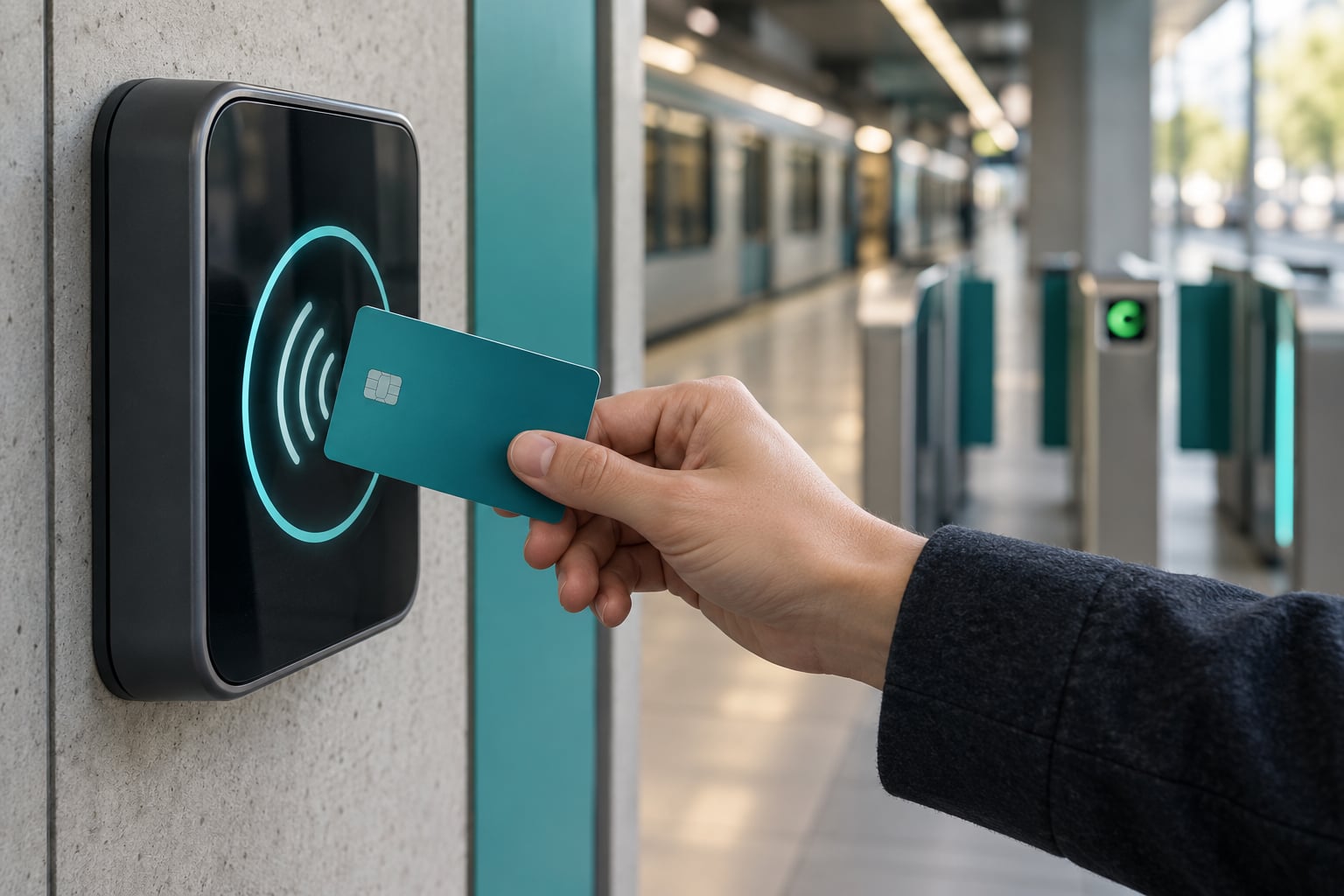
How contactless transit payment systems work is simple in outline: a rider taps a bank card, phone or watch on a fare reader, the fare is charged straight to that payment account, and there is no separate transit card to buy, load or top up. Your card and the reader talk to each other over a short-range radio link, the fare is approved, the gate opens, and the money moves later in a batch. That is the whole loop, and the rest of this guide unpacks it piece by piece.
It matters because ticketing used to be one of the messiest parts of running a city. Cash has to be counted, secured and insured. Stored-value cards have to be manufactured, distributed, sold and replaced when they break. Contactless payments push most of that work onto the card network the rider already uses.
Table of Contents
- What Is a Contactless Transit Payment System?
- How Contactless Transit Payment Systems Work Step by Step
- What Happens When a Rider Taps In or Out?
- How the System Knows Which Fare to Charge
- Do You Need a Transit App or Special Card?
- How Secure Are Contactless Transit Payments?
- What Happens When the Network Is Down?
- How Transit Agencies Calculate and Collect the Money
- How Accessibility and Rider Privacy Are Protected
- What Benefits and Challenges Do Cities Experience?
- What Should a City Check Before Deploying One?
- Frequently Asked Questions
- Can you use any contactless card to pay for transit?
- What happens if you forget to tap out?
- Are contactless transit payments processed instantly?
- Does the transit operator receive your full card number?
- Can you use one contactless payment method across several cities?
- Conclusion
What Is a Contactless Transit Payment System?
A contactless transit payment system is a fare collection setup where riders tap an existing contactless card, phone or watch at a validator, and the fare is charged to that payment account instead of a transit-specific card holding stored value.
The terms you will hear most often are contactless EMV, usually written cEMV, and open loop. Contactless EMV is the chip-and-radio payment standard, defined by EMVCo, the group that maintains the same chip specification used by retail terminals. Open loop means the payment account and the money belong to a bank or card issuer, not to the transit agency. The agency is the merchant of record in that arrangement, but it never holds the rider’s funds.
The opposite model is closed loop. A closed-loop smart card holds a balance that the agency controls, and the agency is responsible for issuing cards, topping them up and refunding them. Many large networks still run a mixed setup, where a rider can tap a bank card at the same reader where a stored-value card works.
Five parties do the work: the rider, the fare reader on the platform or bus, the validator and back-office system behind it, the transit operator, and the payment service provider and card network that move the money.
How Contactless Transit Payment Systems Work Step by Step
This is the sequence that answers the query most directly, from the tap to the settlement batch.
- The tap. The rider holds a card, phone or watch within a few centimetres of the reader. Near field communication, or NFC, opens a short-range radio link between the two.
- Identification. The card shares a tokenised identifier and a public key certificate rather than the full card number. The reader learns which account to bill without ever holding the real number.
- Authentication. The reader checks the card’s signature so nobody can replay a copied identifier, and checks the amount on file against what the operator has declared.
- Fare calculation. The validator applies local fare rules: entry fare, zone, distance, transfer window, concession status and any cap already reached today.
- Authorisation. A small amount, or the full fare, is sent to the issuer for approval. The reader has well under a second to return a go or no-go.
- Gate release. On approval the gate opens or the driver marks the boarding, and the rider is through.
- Posting. The transaction record is stored at the validator, then pushed to the operator’s back office, often in a nightly batch rather than in real time.
- Settlement and clearing. The payment service provider bundles many small fares into a settlement file, the acquirer and issuer move the money, and the operator receives one amount per batch rather than one payment per tap.
- Refund and reconciliation. Corrections, missed tap-outs and overcharges are adjusted in later batches, which is why a statement change can show up a day or two after the ride.
Two details ride explain the pauses riders notice. Aggregation means many two-dollar taps are combined into one claim, because the cost of processing a payment is roughly flat regardless of size. And authorisation is not always real time; a validator with a weak signal will use a stored record and settle later.
What Happens When a Rider Taps In or Out?
Whether a second tap is needed depends entirely on the fare model the agency picked. A flat-fare city bus only needs an entry tap, because the fare is known at boarding. A commuter rail line that charges by distance needs both an entry and an exit tap, because the fare is not known until the journey ends.
Say a rider boards a suburban rail service from a zone 2 station, rides two zones out and taps off. Under an entry-only model there is no second tap at all, and the system charges the boarding fare. Under an accumulation model the entry tap opens a journey, the exit tap closes it and charges the full distance fare, and if the rider forgets the exit tap the system closes the journey later and applies whatever the maximum fare rule says.
| Fare model | Tap sequence | What the system needs to know | Best fit |
|---|---|---|---|
| Entry-only, known fare | One tap on board | That a boarding happened | Flat-fare buses and trams |
| Tap in, tap out | Tap on entry, tap on exit | Start and end points, time in between | Commuter rail and metro with zone fares |
| Distance or zone based | Tap on entry, tap on exit | Zone map, route, time of day | Regional rail and multi-operator networks |
| Card as credential | Tap on board | That a valid ticket exists on the account | Pre-purchased passes and subscriptions |
Conventions differ by country, and one rail contributor noted that in many German systems the on-board contactless tap buys a ticket rather than recording a journey start. Riders moving between countries should not assume the tap pattern travels with them.
How the System Knows Which Fare to Charge
The fare is not on the card. It lives in the operator’s fare rules, and the tap supplies the context that lets those rules fire.
| Input | Where it comes from | Effect on the charge |
|---|---|---|
| Entry station or stop | Reader location | Sets the starting zone or fare band |
| Exit station or stop | Second reader | Turns the boarding fare into a distance fare |
| Time of day | Validator clock | Off-peak and evening discounts apply |
| Card identity | Tokenised identifier | Links to a concession profile or pass |
| Earlier taps today | Back-office fare store | Trigger transfer discounts or a daily cap |
| Pass or subscription on file | Account record | Charge becomes zero until the entitlement runs out |
Fare capping is the part riders care about most and understand least. Under a capped model the back office tracks every tap made with that identifier during a rolling period. Once the total hits the cap, later taps on the same card generate a zero-amount transaction instead of another fare. Capping removes the anxiety of a missed connection and makes cashless payment behave more like a pass than like a series of separate charges.
Concessions are harder. A senior or student fare normally needs proof, and an open-loop card carries no proof at all. Agencies solve this by registering the rider against a Payment Account Reference, a token that links the card to a verified identity without exposing the card number itself. A rider without a bank account can still get a concession, but usually only through a registered account rather than by tapping any card in a wallet.
Do You Need a Transit App or Special Card?
No, and that is the point of open loop. The rider’s existing card or phone is the ticket. In practice there are five options and they behave differently.
- Bank cards. Tap a debit or credit card on the reader. Funds come straight from the bank account, so a rider needs no relationship with the transit agency at all. Acceptance depends on the card’s network and whether the reader supports it.
- Mobile wallets. A phone or watch holds a device token that rotates, which is safer than a physical card because there is nothing to steal. Device tokens also cost the issuer money to provision, so issuers sometimes restrict their use on transit readers.
- Stored-value transit cards. The agency issues the card and holds the balance. Control is total, but so is the burden: manufacture, distribution, refunds and replacements.
- Pre-purchased passes. The card becomes a credential. The rider bought a pass, and the tap only proves the pass is active. This is the card-as-credential model, and it removes fare calculation from the tap entirely.
- Account-linked virtual cards. A registered account issues a single-use card number for a stored product. Useful for riders who have no bank card or who need a discount profile attached.
Acceptance mode catches people out. One commuter in Melbourne found their card only worked when the reader was set to the Visa or Mastercard mode, and silently failed when the reader defaulted to EFTPOS. The same reader, the same card, opposite outcomes.
How Secure Are Contactless Transit Payments?
A transit tap is a small retail payment in disguise, and it inherits most of that security model while adding one hard constraint: the decision has to be made in the time it takes a gate to open.
Three pillars carry the transaction. Card authentication confirms the card is genuine and unmodified. Cardholder verification confirms the token maps to a real account. Financial authorisation confirms the issuer will pay. Drop any one and the ride either fails or, worse, succeeds against a card that should never have been charged.
Tokenisation does the heavy lifting. The reader receives a tokenised device identifier and the transaction message is encrypted end to end, so the operator’s back office usually handles a token, a Payment Account Reference and an amount rather than a card number. That keeps most of the system outside the scope of the payment card industry’s data security rules, which is why transit operators rarely need to become fully certified card data holders.
Controls on top of that include per-tap value limits, per-day and per-device limits, a deny list of cards or devices that fraud teams want blocked, and periodic re-checking against the issuer. Riders notice deny lists most when a card is blocked after a tap that looked successful, with no explanation on the display. That is why clear support paths matter as much as the technical control.
Chargebacks exist too, and a rider who is overcharged can raise one, though the process usually runs through the bank rather than the agency.
What Happens When the Network Is Down?
Nobody waits for a mobile signal to board a bus, so validators are built to accept a tap and sort it out later. That is the honest answer, and it is also where most rider frustration comes from.
When a reader cannot reach the issuer, it checks the card against a stored deny list, applies local fare rules for a known-fare model, and records the transaction as a pending authorisation on its own storage. The gate opens. The fare is not yet guaranteed to be collectable. Later, when connectivity returns, the batch is transmitted and the issuer either honours it or the ride is written off as a small loss to the operator.
That is the risk trade-off made plainly: speed and access for riders against a small amount of uncollectable fare. Operators accept it because riders who cannot get through the gate do not come back at all.
Some agencies pair offline operation with a limited-entry mode that switches on during planned outages, letting everyone through and collecting fares afterwards from an approximation, or turning the gates to open mode for a defined window. Offline behaviour is not standardised, so riders should not assume one agency’s outage rules apply in another city.
How Transit Agencies Calculate and Collect the Money
The money travels through five parties, and each one does a different job with it.
| Party | Role | Money handled |
|---|---|---|
| Rider | Initiates and authorises | Holds the balance; sees the charge on a statement |
| Transit operator | Merchant of record | Receives a batched payment for rides delivered |
| Payment service provider | Aggregates and routes | Files claims, applies corrections, handles disputes |
| Acquirer and issuer | Move funds, take fees | Net the operator’s amount after interchange |
| Auditor or back office | Reconciles | Matches taps to settlements and fare revenue |
The economics turn on two numbers: interchange per transaction and the average fare. Transit fares are small, so a per-transaction fee eats a large share of revenue at a small rural agency. Aggregation and capped interchange rates exist for exactly this reason, and some agencies negotiate a flat percentage instead. Regulators in some jurisdictions have also stepped in to cap what a debit transaction can cost, while leaving credit interchange less regulated, which is one reason many operators steer riders toward debit and prepaid.
How Accessibility and Rider Privacy Are Protected
Two different questions sit here: how a rider gets a discount, and how much the agency learns about them.
On discounts, the pattern is consistent. The rider registers once, proves eligibility through whatever the agency accepts, and the proof is linked to a Payment Account Reference rather than to a card number. Renewal reminders, address changes and revocations all run through the account, not through the payment credential. Accessibility at the reader matters just as much: raised targets, audio confirmation, tactile markings on the reader, enough time at a wide gate for a wheelchair or a walker, and staff who know the manual fallback when the automated path fails.
Cash and closed-loop cards still need to exist as a fallback. A system that only accepts a payment credential it does not issue locks out riders with no bank account, prepaid-only cards and children who cannot hold a card steady. That is a design failure, not an edge case.
On privacy, the useful rule is data minimisation. The fare system needs the token, the amount, the time and the place. It does not need a profile, a photo or a travel history that follows someone around. Records are best limited to the reconciliation window, with personal travel patterns anonymised before anyone analyses them. Fraud screening needs transaction behaviour, not identity, which is why device identifiers and deny lists work as well as they do. A contactless tap is not a biometric event and should never be used as one.
What Benefits and Challenges Do Cities Experience?
The case for contactless payment is strong and well documented. The case against it is real too.
| Benefits | Challenges |
|---|---|
| Faster boarding and shorter dwell time | Reader hardware costs money to buy, install, secure and maintain |
| No queues to buy or load tickets | Interoperability between agencies and regions takes years |
| Cash handling, cash offices and card stock drop away | Disputes, refunds and chargebacks need real support staff |
| Better boarding data for planning routes and capacity | Unbanked riders need a funded alternative path |
| Visitors can pay without learning a local system | Outages are visible and public, and riders blame the operator |
| Concessions can attach to verified identities | Dependence on one vendor for readers, back office and settlement |
Reduced dwell time is the number riders feel directly: one rider-facing study reported boarding time reductions of roughly a quarter on gates with open-loop acceptance. The cost side is quieter and harder to argue down, because the savings come from retiring old equipment and cash operations gradually rather than on launch day.
What Should a City Check Before Deploying One?
A municipal team that has done this before usually works through the same sequence. Here is a practical order of operations.
- Inventory what already exists. Which fare media are in the field, how many readers are in service, and what would be retired.
- Settle the fare policy first. Entry-only or tap in, tap out, flat fare or zoned, and whether capping is offered. The payment system implements a policy; it does not invent one.
- Model the back office. A card reader at the gate is the cheap part. Fare calculation, capping, concession matching, reconciliation and refunds are the expensive part.
- Check reader standards and certification. Readers have to meet the same acceptance rules as retail terminals, and the fleet needs a plan for replacement cycles.
- Plan accessibility and fallback. Cash, closed-loop cards, staffed gates and audio feedback all stay in the plan, with funding attached.
- Write the privacy rules before launch. Retention periods, who can see travel data, and what is anonymised.
- Staff customer support. Riders who are stranded at a gate will call. Budget for the calls before the gates open.
- Run a procurement process that tests migration. Ask vendors to demonstrate fare capping, concession matching and a failed-tap recovery path, not a demo tap.
- Pilot on part of the network. One line or one bus division, with baseline boarding times and fare loss measured before and after.
- Publish the performance measures. Dwell time, fare loss, decline rates, support volume and cap accuracy, reported on a schedule riders can check.
Frequently Asked Questions
Can you use any contactless card to pay for transit?
No. The card must be enabled for contactless payments and issued on a network the reader accepts, usually Visa or Mastercard. Prepaid, gift and benefit cards are accepted on some systems and rejected on others, and mobile wallets can be limited by the issuer because device tokens cost money to provision. If a tap fails silently, check which payment mode the reader is set to before assuming your card is faulty.
What happens if you forget to tap out?
On an entry-only system, nothing happens beyond the single boarding fare. On a tap in, tap out system, the journey is closed by the operator using the entry record and a distance or maximum fare rule, and the charge lands on your statement a day or two later. Riders have seen corrections appear roughly 48 hours after an incorrect tap-out, so a mistaken fare is usually reversible through the agency’s customer service.
Are contactless transit payments processed instantly?
The decision at the reader is instant, but the money is not. Most operators aggregate many small fares into a batch, send it to the payment service provider and receive one settled amount later that night or the next day. That batching is what makes low-value transit payments economic. Riders also see corrections days later, because a missed tap-out or an overcharge is fixed in a subsequent batch rather than instantly.
Does the transit operator receive your full card number?
Usually not. The reader passes a tokenised device identifier and an encrypted transaction message, and the operator’s back office works with that token, a Payment Account Reference and an amount. Keeping the real card number out of the fare system is what allows operators to avoid full payment card data security certification. Riders should still treat their bank statement as the authoritative record of what was charged.
Can you use one contactless payment method across several cities?
Sometimes, and it depends on agreements rather than technology. A bank card works in any city whose reader accepts the same network, so one card can pay fares in several places, but fares, caps and transfer rules are set locally and will not carry over. Regional interoperability schemes let a single identifier span participating agencies. Without one of those, you are carrying a working card that behaves like a different ticket in every city.
Conclusion
How contactless transit payment systems work comes down to one loop: a card talks to a reader, the reader applies the operator’s fare rules and asks the bank for approval, the gate opens, and the fares are gathered up and settled in a batch afterwards. The reader decides fast, the back office decides accurately, and the bank decides finally.
The practical first step is smaller than it sounds. Find out what fare model your transit agency uses and which payment media it accepts, then match that to a card or wallet you already have. Everything else, from capping to concessions to what happens when a tap fails, follows from those two answers.