
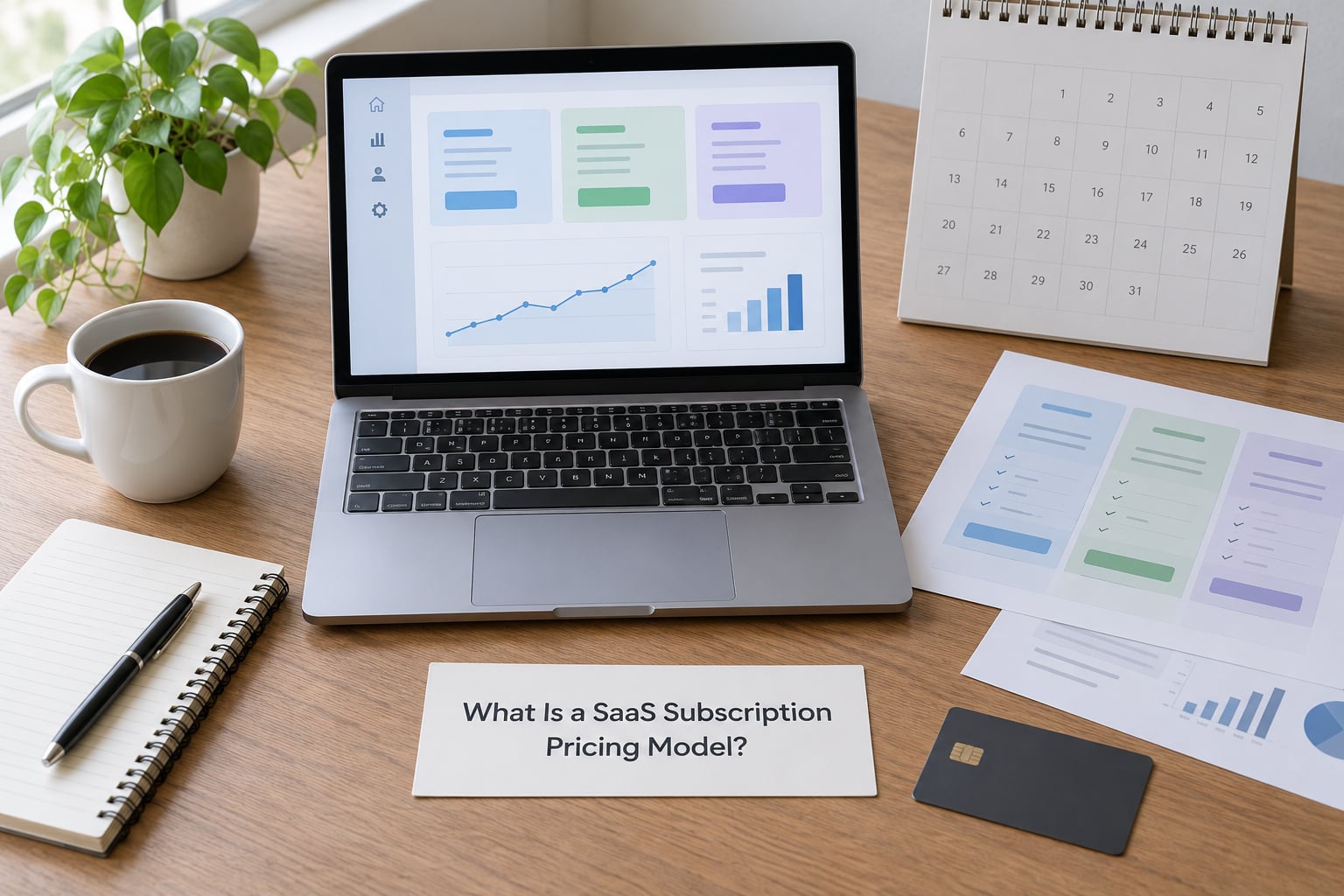
A SaaS subscription pricing model is the rule a software company uses to decide what a customer pays for and how often. The model turns a one-time software purchase into recurring revenue by pairing access to the product with a billing basis: a flat monthly fee, a per-seat licence, a usage meter, or a blend of all three.
Most teams get this wrong in a predictable way. They copy a competitor’s pricing page, bolt on a middle tier nobody wanted, and then wonder why the invoices surprise customers. Understanding the mechanics first is less glamorous than picking a number, but it is what separates a pricing model that renews from one that generates support tickets.
This guide walks through how a subscription bill actually gets built, the main models and where each one breaks, how to test a change before committing to it, and how the whole thing looks when the buyer is a city department working inside a fixed annual budget.
Table of Contents
- What Is a SaaS Subscription Pricing Model?
- How Do SaaS Subscription Prices Get Calculated?
- SaaS Subscription Pricing Models at a Glance
- What Are the Main Pricing Models?
- What Is Tiered Pricing?
- How Does Usage-Based Pricing Work?
- What Should a SaaS Product Charge For?
- How Can a Business Test and Change Its Pricing?
- How Do SaaS Businesses Manage Renewals, Discounts, and Revenue?
- How Can You Choose the Right Pricing Model?
- How Does Subscription Pricing Apply to Smart City Apps?
- What Metrics Help Evaluate a SaaS Pricing Model?
- What Are Common SaaS Pricing Mistakes?
- Frequently Asked Questions
- What is the most common SaaS subscription pricing model?
- Is tiered pricing the same as usage-based pricing?
- Should SaaS companies offer monthly and annual plans?
- How do free trials affect subscription revenue?
- What is a good pricing model for a civic or government SaaS product?
- How often should a SaaS company change its prices?
- Conclusion
What Is a SaaS Subscription Pricing Model?
Recurring revenue is the point. A one-time licence fee is recognised once; a subscription is recognised across the term of the agreement, which is why software companies care so much about monthly recurring revenue (MRR) and annual recurring revenue (ARR) rather than quarterly sales figures.
Underneath that, every subscription pricing model is assembled from three parts. Access may be free, which buys trials, trials and free tiers. A base charge sits in the middle, either a flat platform fee or a per-seat licence. On top, a variable component scales with usage, consumption or delivered outcome. Most modern products use all three: a free tier for evaluation, a platform fee for reliability, and usage charges for the part of the product that costs the vendor real money.
Worth separating two words that get used interchangeably. The pricing model is the billing mechanic, the structure of the bill. The pricing strategy is the commercial decision around it, where you position against rivals, whether you discount, how you package. A model answers “how is this invoice calculated”, a strategy answers “why is the number this high”.
How Do SaaS Subscription Prices Get Calculated?
Every subscription invoice, however simple the pricing page looks, is assembled in the same order. The billing period comes first, then the base charge, then the usage that exceeded whatever was included, then add-ons and discounts, then tax, then the total.
- Billing period. Monthly, quarterly or annual. The period sets the clock for everything else, and it decides whether the vendor collects cash up front or spreads it out.
- Base charge. The fixed part of the subscription: a platform fee, a per-seat price multiplied by assigned seats, or a tier price.
- Included allowance. What the base charge already covers, such as a number of active users, a volume of data or a response-time promise. This is the most misunderstood line on most pricing pages.
- Metered consumption. Everything above the allowance, counted during the period and charged at the stated overage rate, or rolled into the next period at a discounted rate.
- Add-ons. Optional modules, extra storage, additional integrations or premium support, usually billed per add-on per period.
- Discounts and commitments. Annual prepay discounts, multi-year terms, nonprofit or public-sector rates, promotional credits.
- Tax and invoice. Tax is applied last, calculated on the taxable portion, and the invoice is issued at the close of the period.
A worked example from a municipal context. A city runs a waste sensor network across roughly 240 collection points and buys a dashboard to visualise fill levels. The annual subscription includes the dashboard, a base fee per site, and a set number of sensor readings per month included in the plan. When a busy month pushes readings past that allowance, the overage is billed at the metered rate. If the city later adds a routing module, that add-on is billed separately at the same renewal date.
Mid-cycle changes are handled through proration. When a customer adds seats or upgrades a tier halfway through a period, the vendor credits the unused portion of the old plan and charges the remainder of the new one, so the customer pays a single adjusted invoice rather than two full amounts.
SaaS Subscription Pricing Models at a Glance
The table below is the fastest way to see how the models differ. Billing logic is what moves on the invoice; the last two columns are the trade-off most teams feel first.
| Model | How billing works | Best fit | Main advantage | Main drawback |
|---|---|---|---|---|
| Flat rate | One fixed price per period, same for everyone | Narrow products with a single clear use case | Nothing to explain, nothing to negotiate | Hard to grow revenue without adding products |
| Tiered | Fixed price per plan, each with its own feature and limit bundle | Products serving customers of very different sizes | Buyers self-select a plan, sales effort drops | Tier gaps get gamed and the middle tier stalls |
| Per seat | Base fee multiplied by the number of assigned users | Collaboration tools where value tracks headcount | Revenue grows with adoption | Seat counts are negotiated down and shared logins appear |
| Usage-based | Metered units consumed during the billing period | APIs, data pipelines, infrastructure and AI products | Customers stop paying for what they do not use | Unpredictable invoices and budget anxiety |
| Credit-based | Customers buy bundles of credits and spend them on actions | Products where one action costs far more than another | Even margins across wildly different workloads | Credit accounting confuses buyers and support |
| Hybrid | Platform fee plus seats, credits or metered usage | Almost everything with both fixed and variable costs | Captures base revenue and upside together | Harder to explain, more billing edge cases |
| Freemium | Free tier with caps, paid tiers for limits and features | Products with a fast time-to-value and low support cost | Product-led acquisition at near-zero sales cost | Free users who never convert still cost money |
| Outcome or value-based | Fee tied to a measured result such as a resolved case or a saved hour | High-value enterprise and public-sector work | Price sits near the value delivered | Measurement disputes and long sales cycles |
What Are the Main Pricing Models?
The eight models in the table overlap more than the names suggest. Flat rate, tiered and per-seat are all fixed-price models that differ in what the fixed price is attached to. Usage-based, credit-based and outcome-based are all variable models that differ in what gets counted.
Flat rate charges everyone the same. It works when the product does one thing, and it fails the moment a small customer and a large one pay the same for wildly different amounts of value.
Per-seat pricing attaches the price to assigned users. It grows with adoption and gives the customer a simple internal justification, the licence covers a named person. It also invites two predictable problems: customers argue about who needs a seat, and people share logins.
Credit-based pricing sells bundles of credits that get spent on actions, with different actions costing different numbers of credits. It is the honest answer when one unit of consumption costs the vendor ten times more than another.
Freemium gives away a capped version and sells around the caps. It only pays off when onboarding is fast and support per free user is close to nothing.
What Is Tiered Pricing?
Tiered pricing charges a fixed price per period for a defined bundle of features, limits and service levels, with two or three versions of that bundle. Feature gates hide capability, usage allowances cap volume, support levels change response times, and price breaks reward longer commitments or larger allowances.
Tiered is the most common SaaS model because it lets buyers self-select. It also causes the most common complaint, which is the gap between plans. Founders describe the space between tiers as demoralising, and buyers describe it as arbitrary, especially when the jump from one plan to the next costs more than an hour of their own time.
The fix is not more tiers. It is making each step up buy something the previous plan genuinely could not deliver, and keeping one of the steps small enough that a mid-sized customer lands on it rather than jumping.
One distinction that causes real confusion: an allowance inside a tier is not the same as usage-based billing. A tier that includes a set number of API calls and then stops charging, or throttles the customer, is a fixed model with a limit. A model that bills every call above that number is metered.
How Does Usage-Based Pricing Work?
Usage-based billing counts what the customer consumes during the period and charges a rate per unit. The vendor meters the event, aggregates it, applies any tiered or volume rate, and invoices at the close of the period. The count usually includes a real-time or near real-time estimate so the customer can watch the bill build, which matters more than most vendors assume.
Three components make up a well-built usage model. A committed minimum gives the vendor a floor and lets them discount safely. An overage rate sets the price above the commitment, often stepping down as volume rises. Billing thresholds tell the customer where the next charge lands.
The strength is alignment. Customers stop paying for capacity they do not use, and vendors stop subsidising heavy users. The weakness shows up in the sales cycle: procurement teams reject invoices they cannot forecast, which is why committed minimums exist. Buyers who cannot cap usage describe the resulting invoices as spiky, and the support tickets that follow are a pricing design failure rather than a customer failure.
What Should a SaaS Product Charge For?
Charge for the unit that scales with the value the customer receives. That is the whole principle, and it is harder to apply than it sounds because most products have several candidate metrics.
- Active users or seats for products where adoption tracks headcount.
- Transactions, cases or records for operational platforms.
- Storage and data volume for platforms that hold customer data.
- Compute, queries or API calls for products with a real variable cost.
- Modules for suites where each add-on is a separate product.
- Service level and support for buyers who care about response times and named contacts.
- Integrations where each connection carries maintenance cost.
- Outcomes for high-value work where the result can be measured credibly.
The test is whether the metric rises when the customer gets more value and stays flat when they do not. Active users beat logins here, because a login count rewards people who signed in twice.
A second test is whether the customer can forecast it. A metric that depends on the vendor’s own efficiency, such as rows processed after a query optimisation, is a poor choice for a buyer on a fixed budget.
How Can a Business Test and Change Its Pricing?
Pricing changes get tested far more than most founders admit, and that is fine. The rule is that customers should never be surprised by what they are charged, only by how much.
- Free trial. Full access for a fixed window, with no card required. Works best for products where value shows up in the first session.
- Freemium tier. A permanently free, capped version. Works when onboarding is quick and each free user costs almost nothing to support.
- Limited plans. Trial the structure rather than the price, then test willingness to pay separately.
- Customer interviews. Ask what the current plan saves, what it costs to run, and which alternative they would switch to. Listen for the unit, not the number.
- Willingness-to-pay research. Present concrete options and price points rather than asking what people would pay in the abstract.
- Pilot offers. Run a smaller paid engagement for a fixed term to learn the real usage pattern before setting list pricing.
- Gradual tests for new customers. Change the price for new accounts and compare conversion and churn before touching existing ones.
When the price eventually rises on existing customers, grandfathering is the gentlest route: existing customers keep their old rate for a defined period while new customers pay the new one. Founders report that this holds revenue growth while keeping churn down. The alternative, immediate repricing with notice, works when the increase is small and the value story is concrete.
How Do SaaS Businesses Manage Renewals, Discounts, and Revenue?
Monthly billing lowers the barrier to entry and gives the vendor a shorter feedback loop. Annual prepay improves cash flow and cuts churn, and it usually carries a discount in the ten to twenty percent range. Buyers dislike monthly plans because price changes arrive as shocks; buyers dislike annual plans when they see a discount right after they commit.
Coupons and promotional credits buy trial without a long sales cycle, and they cost nothing if they are limited. Setup fees and onboarding charges are reasonable where onboarding is genuinely labour-intensive, and they are hard to defend when onboarding is self-serve.
Minimum commitments, usually expressed as a committed monthly spend, are the standard hedge on usage-based pricing. They convert a variable model into a partly predictable one without pretending the usage is fixed.
Upgrades usually take effect immediately with proration, downgrades at the next renewal. Refunds are rare in B2B subscription billing and more common in self-serve consumer products. Revenue recognition rules mean an annual contract paid up front is not all recognised in month one, which is why ARR and recognised revenue rarely match.
How Can You Choose the Right Pricing Model?
Work through these seven questions in order. The first three usually settle it.
- What does value scale with? Pick the metric that moves when the customer succeeds. Everything else follows from this.
- How variable is your own cost? If serving a customer costs about the same whatever they do, price fixed. If cost tracks consumption, price variable.
- Can your buyers forecast the bill? Public-sector and enterprise procurement teams often cannot accept a purely variable invoice.
- How different are your customer segments? Similar customers suit flat rate or a single seat price. Very different sizes suit tiers.
- What is your sales motion? Self-serve products sell tiers. Enterprise products negotiate commits, discounts and bespoke terms.
- What does support cost per customer? Expensive hand-holding pushes prices up and argues for a higher floor on the free tier.
- What do you need the forecast to look like? Board plans and grant budgets reward predictability even when it costs some upside.
A good default for most B2B products is tiered with a per-seat base and usage only where cost genuinely varies. It is not the most elegant model, but buyers can explain it to their finance team in one sentence.
How Does Subscription Pricing Apply to Smart City Apps?
Public-sector buyers change the arithmetic. A city department has an annual budget cycle, a procurement calendar and a formal contract, which means a model that produces unpredictable monthly invoices is close to unusable.
In practice, that pushes smart-city products toward annual subscriptions with a defined scope. A mobility dashboard sold to a mid-sized city typically carries an annual platform fee, a module fee for the specific service being managed, and a seat count tied to staff rather than residents. Waste and environmental sensor networks price closer to utilities, per site or per endpoint per month, with overage handled as extra endpoints rather than surprise charges.
Citizen-service portals follow a different pattern because the user base is the public. Charging per resident account rarely works, so the fee sits with the department, tied to population bands or transaction volumes, and access to citizens stays free. Open-data platforms monetise through API consumption by developers and research partners, usually with a free allowance and metered access above it.
Two constraints shape everything else. Grant funding often covers a capital or pilot period but not ongoing subscription renewal, so the year-two cost has to survive without it. And contract terms tend to be longer and slower to change, which argues for a model that does not need frequent repricing.
What Metrics Help Evaluate a SaaS Pricing Model?
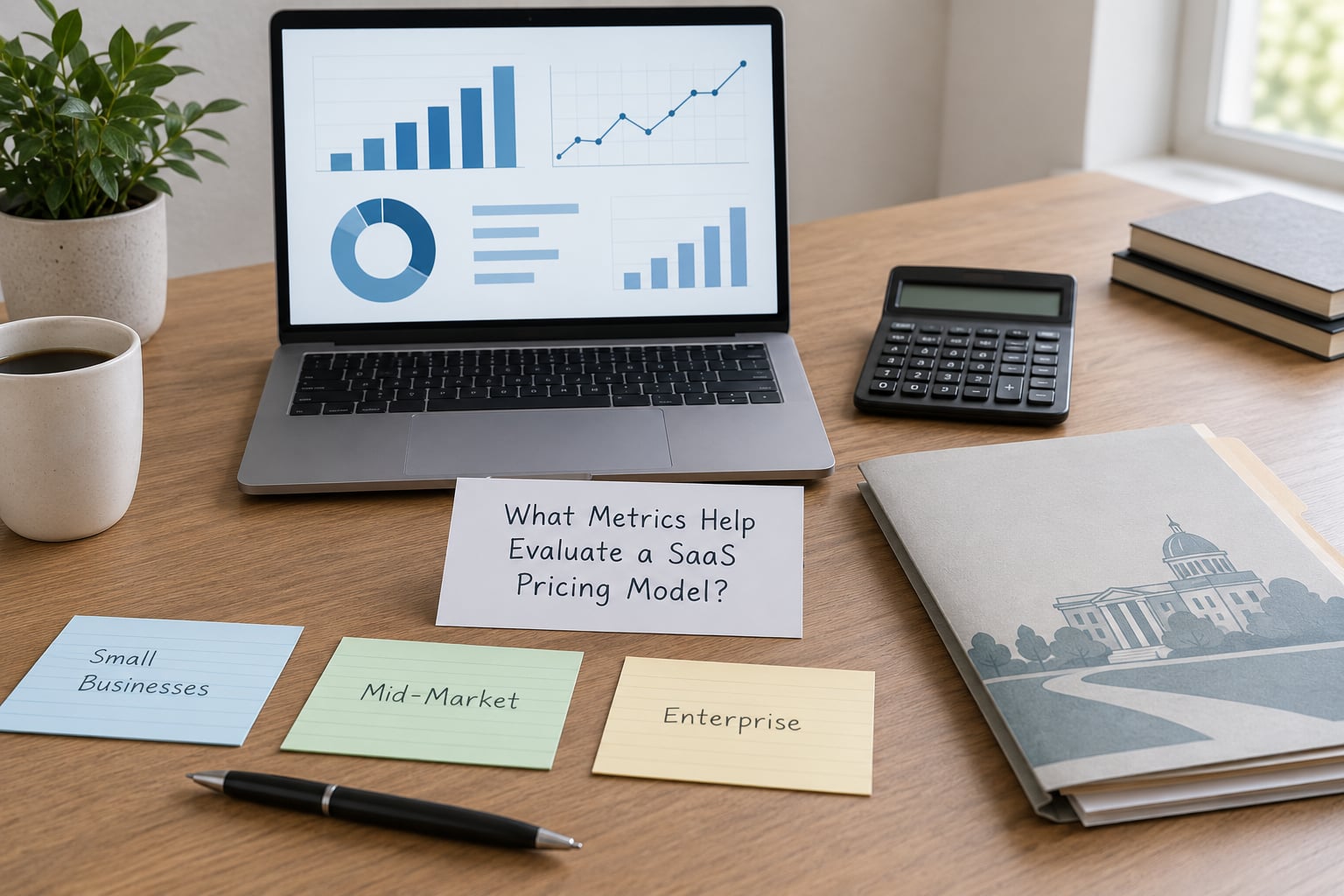
A pricing model earns its keep when the numbers underneath it behave. These are the measures worth watching, and what each one tells you about the model.
- Conversion rate from pricing-page visit to paid account. Flat and tiered models move this most; usage models often convert on a later step.
- Trial-to-paid rate. The clearest signal that a free tier or trial is doing its job.
- Average revenue per account or per user (ARPA/ARPU). Rises with seat expansion and add-ons, falls when customers consolidate.
- Gross margin. Usage models can erode margin if overage rates sit below the true cost of serving.
- Churn rate by plan and by segment. Tiered models hide churn inside downgrade rates, so track movement between plans.
- Expansion revenue and net revenue retention. The clearest evidence that the price metric matches value.
- CAC payback period. Long payback argues for annual prepay and for raising prices rather than buying more leads.
- Forecast accuracy. The variance between expected and actual bills, which is where usage models get judged.
Two numbers come up constantly in pricing discussions. The rule of 40 says a healthy SaaS business adds MRR growth rate and churn rate to reach at least 40 percent. The 3-3-2-2-2 rule of thumb describes enterprise sales efficiency: roughly three times growth in a year, three times pipeline, two times sales efficiency, two times win rate, two years to payback. Neither proves a pricing model works. They describe whether the rest of the business can afford it.
What Are Common SaaS Pricing Mistakes?
- Too many plans. Five or six tiers means every buyer has to have a conversation with sales, which defeats the point of self-serve.
- Unclear limits. If the pricing page does not say what is included, the first invoice will feel wrong even when it is correct.
- Hidden fees. Charges for onboarding, data export or support that appear after the contract is signed.
- Pricing before value is proven. Launching with a permanent discount teaches customers to wait for one.
- Usage rates below cost. Overages priced for competitiveness rather than for what serving the request actually costs.
- Arbitrary tier gaps. A jump of several times the price for one extra feature reads as a trap.
- Complex terms. Anything a customer cannot explain to their own finance team slows the sale and the renewal.
- Sudden repricing. Raising prices on existing customers with short notice is the fastest route to churn.
Frequently Asked Questions
What is the most common SaaS subscription pricing model?
Tiered pricing is the most common, usually combined with a per-seat base. It lets buyers self-select a plan instead of talking to sales, and it scales from small accounts to enterprise ones. The tradeoff is tier management: too many plans create confusion, and awkward gaps between plans push customers to the cheapest viable option.
Is tiered pricing the same as usage-based pricing?
No. A tier sets a fixed price for a bundle of features and limits, and an allowance inside that tier is a cap rather than a billing trigger. Usage-based pricing meters what the customer consumes and charges for it. A tier that includes a call allowance and then bills every call above it is really a hybrid, and it needs to be described that way.
Should SaaS companies offer monthly and annual plans?
Usually yes. Monthly lowers the barrier and shortens the feedback loop; annual prepay improves cash flow and reduces churn, usually with a discount in the ten to twenty percent range. Watch how each cohort behaves: monthly customers experience price rises as shocks, while annual customers notice when discounts appear right after they commit.
How do free trials affect subscription revenue?
A trial trades short-term revenue for faster evaluation. It works best when the product shows value in the first session, since conversion drops sharply once the trial gets long. Freemium goes further by giving away a capped tier permanently, which suits products with low per-user support cost and punishes products where every free account needs help.
What is a good pricing model for a civic or government SaaS product?
An annual subscription with a clearly defined scope, a per-seat charge tied to staff rather than citizens, and modules priced separately. Public buyers work inside fixed budget cycles and formal procurement, so predictable invoices matter more than maximum flexibility. Add a free allowance where usage can spike, such as API access for an open-data platform.
How often should a SaaS company change its prices?
Once or twice a year is plenty for most products, and more often than that reads as instability. Test changes on new customers first, then apply them to existing accounts with notice, and grandfather existing customers onto their old rate for a defined period. Small increases tied to a concrete value story cause far less churn than a single large one.
Conclusion
Settle four things before you pick a number: the value metric the price attaches to, the customer segment you are designing for, the budget tolerance your buyers work inside, and the cost drivers that make a fixed price unsafe.
Everything after that is mechanics, and mechanics are learnable. That is what how SaaS subscription pricing models work comes down to in 2026: choose the metric that tracks customer value, keep the invoice predictable enough that finance can approve it, and change it deliberately rather than in a panic.