Most founders who reach their first 1,000 app users do it with three things running at once: one tightly defined audience, an app that reaches a useful result within the first minute, and two or three focused launch channels feeding each other instead of competing. Buying traffic first is the most common route to nowhere, because paid installs amplify an onboarding problem rather than fixing it.
Learning how to get your first thousand app users is mostly a discipline problem, not a budget problem. This playbook walks through the sequence stage by stage: who you are targeting, what has to be true before you send anyone a link, where the first users actually come from, and how you measure whether they stuck. It suits solo developers, small teams and civic-tech or smart-city groups whose users all live in one city, one campus or one profession.
A realistic timeline is 60 to 120 days for an organic launch, faster when paid support is available and the niche is favourable. The variable that moves that number most is not budget. It is whether a new user reaches a genuine result on their first session, and comes back without being chased.
Table of Contents
- What You Need
- Step-by-Step: How to Get Your First Thousand App Users
- 1. Narrow the first-user target
- 2. Fix the path to first value
- 3. Find communities where the users already gather
- 4. Launch through focused channels
- 5. Turn interested people into active users
- 6. Earn shares and referrals
- 7. Measure progress and repeat what works
- Common Mistakes
- How to get your first thousand app users without chasing vanity metrics
- Tips for a Sustainable First 1,000
- Frequently Asked Questions
- How long does it take to get the first 1,000 app users?
- Can I get 1,000 app users with no advertising budget?
- Should I use social media to get my first 1,000 app users?
- How do I get more people to download my app from the app store?
- What is the best referral reward for an early-stage app?
- When should a startup start paying for app users?
- Conclusion
What You Need
Before you promote anything, you need five things in place, and four of them cost nothing but thinking time.
- One defined early user. Not “people who want to save money” but a specific person with a real job to do right now.
- A one-sentence description of the problem. If you cannot say it in a sentence a stranger would repeat back correctly, the store listing will not either.
- Baseline metrics. Know your install-to-signup rate, your activation rate and your day-7 retention before you spend anything.
- Time and budget, stated honestly. Two focused channels need roughly 10 to 15 hours a week of real attention.
- A map of where your users already gather. Groups, forums, events, newsletters, local organisations, professional networks.
- Store assets and analytics. Icon, screenshots, a description written for a human, plus event tracking in App Store Connect or Google Play Console so you can see where installs came from.
If analytics is not wired up yet, that is the first item to fix. Without per-source tracking you will spend the next three months guessing which channel worked, and you cannot fix a channel you cannot see.
Step-by-Step: How to Get Your First Thousand App Users
The process runs in seven stages, and the order matters more than the tactics. Each stage produces an input the next one needs, so skipping ahead usually means paying for users before the app can keep them.
1. Narrow the first-user target
Write a profile of your first 1,000 users built from an urgent job, a context and a location. Not a demographic, a situation: a person in a specific place who has a problem right now that your app removes.
Choose one primary segment and ignore the rest until you clear 1,000. The most useful version of this sounds like “independent venue operators in mid-sized European cities who need to fill midweek seats and already use ticketing software they dislike”. Narrow sounds uncomfortable at first because it caps your market, and the cap is the point. You cannot write a message that lands with everybody.
Then write a plain-language value proposition: who should use the app, what changes for them, and why it is worth adopting now. Two sentences. If your description leads with a category name nobody outside your industry uses, rewrite it in the words your users would use to describe the problem.
2. Fix the path to first value
The distance between opening the app and getting something useful should be as short as you can make it. Sign-up friction is the most common leak: every required field, every permission prompt before it earns trust, every mandatory tour costs you users you already paid for.
Three fixes do most of the work. Move account creation until after the first useful action, ask for permissions at the moment the feature needs them rather than at launch, and cut onboarding to the one thing that shows the app is worth keeping. Test that path with five people who are not friends and watch where they hesitate without helping them.
Now define activation as a single observable action, and set benchmarks you can actually judge rather than invented industry averages. A useful activation definition is behavioural: the user completed the action that predicts they will return. Measure it, and treat day-7 retention below roughly 20 percent for a new consumer app as a signal that the product, not the promotion, is the problem.
3. Find communities where the users already gather
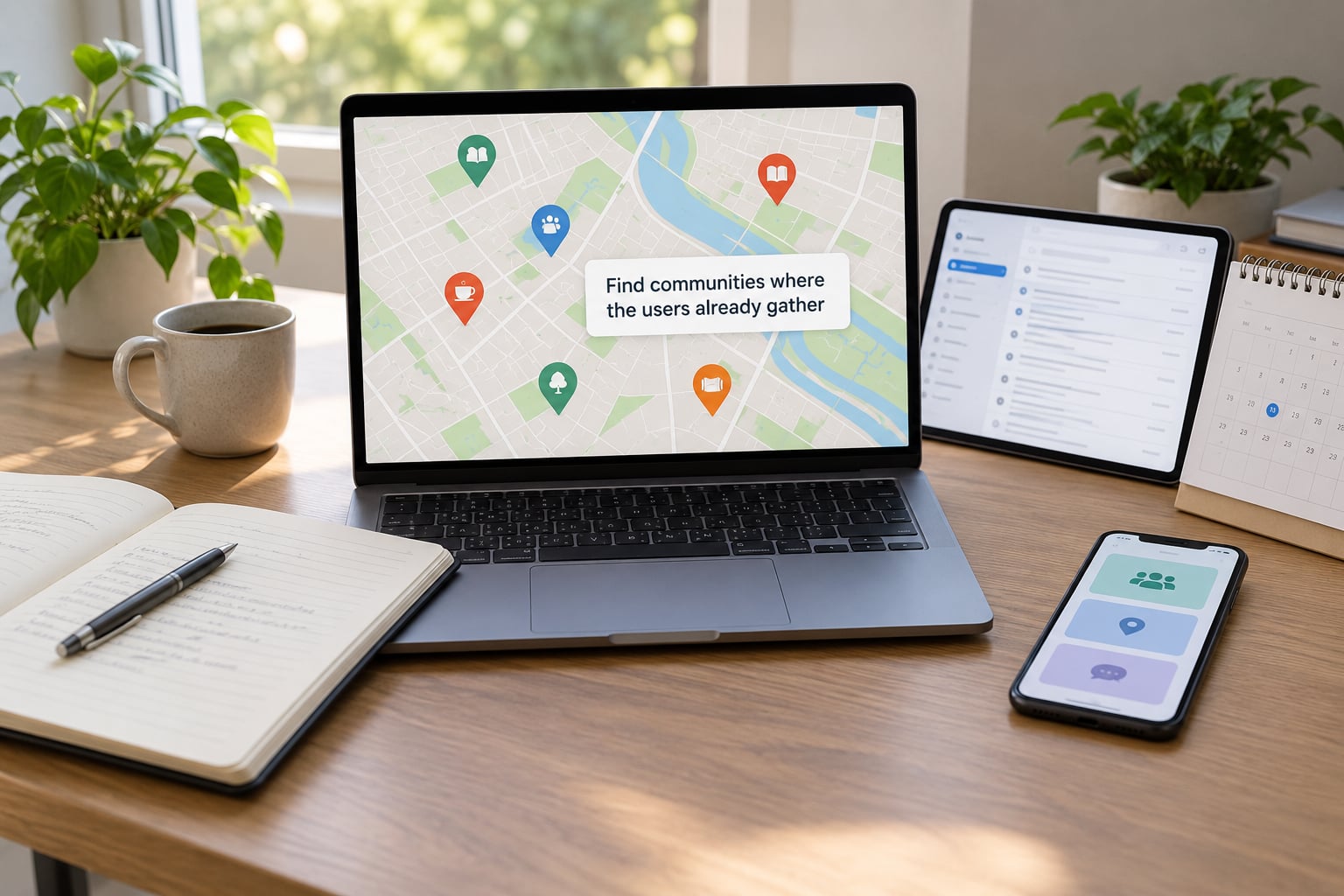
Your first users already gather in specific places, and those places are findable in an afternoon. Build a list of the subreddits, Discord servers, Slack groups, Facebook groups, forums, newsletters and meetup groups where your segment talks about the problem without talking about solutions.
Rank them by how active the group is and how closely the discussion matches your segment, then drop the ones where the audience is large but vague. Founders repeatedly report that posting in a big general group produces downloads and almost no retained users. The narrow group of 400 people who know your problem beat 40,000 people who scroll past.
Write your contribution rules before you publish anything. Decide in advance what you will answer, how often you will show up without a link, and what you will never do. The rule of thumb that works is roughly ten genuinely useful replies for every product mention. One founder’s launch post in a community he had never contributed to was ignored, while another founder in the same period got real traction after weeks of unlinked participation.
For civic, municipal and campus apps, add the local layer: city open-data portals, university societies, transport and parks departments, local press. A city that publishes parking occupancy data has an audience of transport geeks, journalists and one very motivated parking officer, and all three are reachable by email.
4. Launch through focused channels
Run two channels at a time, not six. Two give you a comparison at the end of the month; six give you six excuses when nothing moves. Typical pairing is community participation plus store optimisation for organic reach, with direct outreach or a small paid search test layered on for immediate volume.
Direct outreach means individually contacting the people your profile describes: the operators, the coordinators, the students running the group chat. Short, specific and about their situation rather than your app converts far better than a broadcast. The same applies to partners: one organisation that already talks to your audience is worth more than any ad campaign at this stage.
Paid search is useful as a measuring instrument even when it is a terrible acquisition strategy. It gives you an immediate read on which store keywords describe real intent. Run it small, on long-tail exact-match terms in one country, and treat the first month as research rather than as scale.
Track every source separately from day one. Give each channel its own link or its own store campaign, and log it in a simple sheet with the date, the source, the clicks and the signups. Founders who mix sources end up scaling whatever channel they happened to check last.
5. Turn interested people into active users
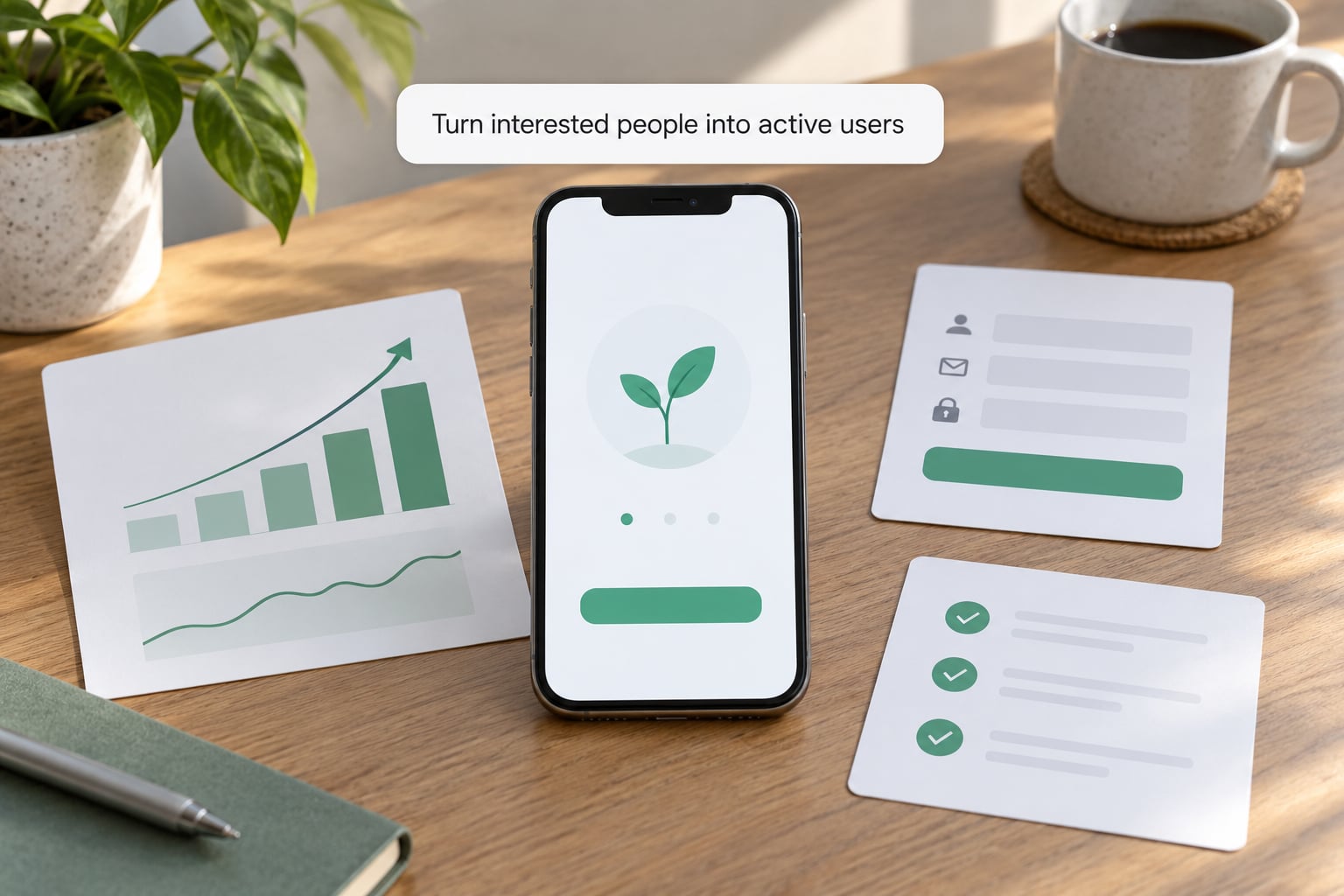
Moving people from download to first meaningful action is where most launches quietly fail. A person who installs your app has expressed curiosity, not commitment, and the first session decides which one they get.
Use contextual invitations rather than broadcast messages. Ask for the referral or the review after the user has already got value, not on the welcome screen. Give people a specific first action that takes under a minute, and hold back the feature tour until they have done it once and come back.
Then find where people actually leave. Break the journey into download, signup, first action, second session and day-7 return, and look at the biggest relative drop between any two steps. That gap is usually one screen, one permission or one confusing label, and it is worth more than any campaign you could run next month.
6. Earn shares and referrals
A referral loop works when the thing being shared is worth sharing. Start with the output your product produces rather than the product itself, because that is what people talk about. One founder reached 2,000 Android installs in weeks after learning that audiences share what they find surprising, not app recommendations.
Three mechanics work in the first 1,000. Make results exportable or screenshot-friendly so sharing costs nothing. Add an invitation that gives both people something real, such as a shared workspace or a saved configuration. And put community challenges or seasonal moments on the calendar so sharing has a reason and a date.
Be careful with rewards. Cash-for-referral schemes attract people who will never open the app again, and they distort your numbers until you notice. Reward the behaviour you want, such as a completed action or a retained week, rather than the install itself. Partner referrals, where a complementary organisation recommends your app to its own members, tend to convert better than any in-app incentive at this scale.
7. Measure progress and repeat what works
Build one weekly funnel and fill it every Friday: exposure, store page views, installs, signups, activated users, day-7 retention, referrals. Seven numbers, one sheet, no dashboard archaeology.
Work in cohorts rather than totals. A weekly cohort that retains at 15 percent tells you something a total of 1,000 installs never will. Then apply stop conditions. Pause a channel when its cost per activated user runs far past what that user is worth over three months, and pause paid acquisition entirely if day-7 retention sits below 20 percent, because paying to send more people into a leaking funnel just drains the budget faster.
Use cohorts to decide what runs next. A channel that produced 40 activated users from 50 signups deserves more of your week than one that produced 200 installs and eight activations, no matter how good the numbers looked on the day. The point of getting to 1,000 is not the number. It is finding out which channel is repeatable before you scale it.
Common Mistakes
Most stalled launches share a small set of causes, and each one has a straightforward fix plus a clear point where to stop.
Buying generic traffic first. Broad targeting sends you strangers who download and disappear, and it teaches you nothing you can reuse. Fix: wait until onboarding converts, then test only long-tail intent terms in one market. Stop when cost per activated user exceeds three times the value you expect from that user over 90 days.
Targeting everyone. A message aimed at a broad audience converts no one in particular. Fix: pick one segment, write for it, and stay there until you clear the milestone. Move on only after the first cohort retains.
Optimising for downloads instead of activation. A download count is a vanity metric unless you know what fraction of those people did the thing that matters. Fix: report installs and activated users side by side, every week.
Changing five channels at once. You end the month unable to attribute anything. Fix: two channels for a full month before you judge either. Change one variable at a time.
Promoting without context. A bare link with no reason to exist gets ignored, and in some communities gets removed. Fix: answer a question people are asking, then mention the app once, and only where participation earns you the right.
Offering rewards before the product delivers value. Rewards amplify a product that does not retain, and they attract the wrong people. Fix: wait until at least a fifth of new users come back on day seven, then test one modest reward.
Confusing installs with users. These are different numbers at every milestone, and optimising the wrong one wastes a quarter. Define both before launch and report both forever.
Posting into silence and quitting early. Organic channels compound slowly, and week two is the worst possible moment to judge them. Fix: commit to a full cycle per channel before you decide anything.
How to get your first thousand app users without chasing vanity metrics
The measurement model that works counts people, not impressions. Track activated users and retained users first, then qualified traffic to your store page, then conversion rate by source, then referrals generated and feedback collected.
Impressions, follower counts and raw download totals tell you nothing you can act on. Two campaigns can produce identical download counts and completely different businesses, because one activated its users and the other produced empty installs. When you report, lead with activated users on a weekly cohort, followed by day-7 retention, and put everything else underneath.
This also changes how you read cost. A channel that looks expensive per install can be the cheapest one you have if those users activate and stay, which is why cost per activated user is the number to compare channels on. Judge every channel against that single figure and the week it produced it.
Tips for a Sustainable First 1,000
Once the launch spike passes, the work shifts from acquisition to making the funnel cheaper. Close the feedback loop first: reply to every store review, especially the one-star ones, since future users read the replies more than the ratings.
Then work on the pieces that compound. Publish narrowly targeted content answering the exact questions your users ask in the communities you already mapped, and keep a steady release-notes rhythm so existing users have a reason to open the app again. Run two or three short user interviews a month and change one thing each time from what you hear.
Finally, convert the people who helped you into distribution. Partner referrals, an ambassador programme in your niche community and a public changelog that credits contributors all give your existing users a reason to bring someone new. At this stage, one retained user who recommends you is worth more than a hundred extra installs.
Frequently Asked Questions
How long does it take to get the first 1,000 app users?
For an organic launch, most teams land between 60 and 120 days. A paid search layer on top of community work and store optimisation can compress that to 30 to 60 days in favourable niches. The variables that matter most are how narrow your audience is, whether you already have an audience to seed from, and how quickly a new user reaches a useful result. Treat any promise of a 1,000 users in a week as a warning sign.
Can I get 1,000 app users with no advertising budget?
Yes, and for many apps that is the only sensible starting point. Niche communities, direct outreach to individuals, store optimisation, partner referrals and content answering your users’ actual questions have all produced first cohorts of this size. The trade is time: budget buys speed, not a working product. Fix onboarding first, then spend nothing on traffic until activation and day-7 retention look healthy.
Should I use social media to get my first 1,000 app users?
Only as a by-product of real participation. Posting a link into a feed nobody reads produces nothing, and it is the most common way founders waste their first launch. Social works when you publish consistently about the problem you solved, answer questions in the communities where that problem gets discussed, and let people find the app through your answers rather than your pitch. Judge it on activated users from that source, not on follower counts.
How do I get more people to download my app from the app store?
Start with the store page, because it is the only asset every channel shares. Put the outcome in the first three screenshots, write the title and subtitle in your users’ own words rather than your category name, and research the exact phrases people search for before choosing keywords. Localise for the markets you actually target. Then test two screenshot variants and keep whichever lifts the store page conversion rate, since every other channel benefits from that lift.
What is the best referral reward for an early-stage app?
Reward the behaviour you want repeated rather than the install itself. Extra premium days for you and your friend once that friend completes a meaningful action, a shared workspace for team apps, or access to a feature your users brag about all work better than cash. Keep the reward modest until day-7 retention is above roughly 20 percent. Referral fraud and one-time seekers distort your numbers long before they distort your revenue.
When should a startup start paying for app users?
Pay when your free channels have shown you that new users activate and return, not before. Paid acquisition multiplies whatever is already happening, including leaks, so running it against an unproven onboarding flow just drains budget. Start with a small exact-match search test in one country to learn which store keywords carry real intent, then scale only when cost per activated user sits comfortably below the value of that user.
Conclusion
Pick one audience, described as a person with a problem in a specific place. Make the app’s first useful result arrive within a minute of opening, before you send anyone a link. Then recruit twenty people by hand from a community your users already belong to, watch what they do, and fix what breaks.
That is the whole answer to how to get your first thousand app users: one narrow audience, immediate value, twenty recruited by hand, then two channels run for a full month with weekly retention cohorts telling you which one to repeat. The founder who reaches 1,000 fastest is usually the one who narrowed the audience earliest and measured retained users rather than downloads.