Broadband affordability programs cut the monthly cost of home internet for households that meet an income limit or take part in a government assistance program. A funder sets a credit, an administrator checks eligibility, and a participating internet service provider applies the credit to your bill so you pay a reduced rate for as long as you stay enrolled.
The mechanics matter more than people expect. Plenty of households qualify on paper and never apply, and plenty apply and drop out during verification. Understanding how the money actually moves is the fastest way to avoid both.
Table of Contents
- What Are Broadband Affordability Programs?
- How Broadband Affordability Programs Work
- How a monthly credit reaches your bill
- Who Can Qualify for a Broadband Discount?
- Where Does the Funding Come From?
- How Does the Application and Enrollment Process Work?
- What Should a Household Look for in a Program?
- Why Do Broadband Affordability Programs Matter for Cities?
- What Challenges Do These Programs Face?
- Frequently Asked Questions
- Do broadband affordability programs require a contract?
- Can I qualify if I already have internet service?
- Are discounted plans fast enough for video calls and remote work?
- What documents do I need to apply for a broadband discount?
- Do broadband affordability programs cover routers and installation fees?
- How long does it take to receive service after applying?
- Conclusion
What Are Broadband Affordability Programs?
A broadband affordability program is a government-funded or provider-funded subsidy that reduces the monthly cost of home internet, and sometimes the cost of the equipment needed to use it, for households that meet an income limit or participate in a qualifying assistance program. The support arrives as a recurring credit on the bill, a one-time device discount, or waived installation charges.
That is different from an ordinary promotion. A promo is a marketing offer a provider can withdraw, change, or limit to new customers at any time. An affordability program has published eligibility rules, an administrator who verifies them, and money already committed by a funder. The catch is that affordability programs are also conditional, and the conditions are where most applications fail.
Two things get confused constantly. An affordability program is not the same as municipal broadband, where a city builds and runs the network itself. It is also not the same as public Wi-Fi, which is free to use but requires you to be somewhere else. Subsidies follow the household; the other two do not.
How Broadband Affordability Programs Work
The whole model rests on five steps. Once you see them in order, the odd gaps between applying and seeing a credit stop feeling like mistakes.
How a monthly credit reaches your bill
- A funder commits money. Congress or a state legislature appropriates funds, or a provider agrees to subsidize a portion of its own pricing. The amount per household is fixed in advance.
- An administrator sets the rules. It publishes income thresholds, the list of qualifying assistance programs, and the plans that count toward the discount.
- You prove eligibility. A national verifier or the provider itself checks your income, your participation in an assistance program, or both.
- You pick a qualifying plan. Only plans on the approved list generate a credit. Choosing an unlisted plan, even a cheaper one on paper, can void the discount.
- The provider applies the credit each month. It shows up as a line item on your statement, and the program periodically re-verifies that you still qualify.
Step five is the one that catches people. The credit is not a refund you chase. It is applied at billing, which means a missed payment, a changed address, or a lapsed re-verification can remove it without much warning.
Providers also build the discount into the price they charge everyone else. Federal programs generally required the provider to contribute part of the credit, so the subsidy lowers your bill and supports the provider’s rate at the same time. Programs without that requirement are closer to a provider discount and more vulnerable when funding ends.
Who Can Qualify for a Broadband Discount?
Eligibility usually rests on one of three tests: your household income relative to the Federal Poverty Guidelines, your participation in a qualifying assistance program, or both. The income thresholds you will see most often are 135% and 200% of the federal poverty level for your household size.
Assistance-program qualification is usually the faster route because there is no income arithmetic. Programs that commonly qualify households include SNAP, SSI, Medicaid, WIC, federal Pell Grant recipients, federal housing assistance, and the National School Lunch Program through free or reduced-price meals.
Households living on tribal lands often qualify for an enhanced benefit rather than the standard one. Rules also vary on existing service. Some programs require that you have no service, others let you switch providers or upgrade an existing line and still keep the credit.
| Program type | What it does | Who typically qualifies | How to apply |
|---|---|---|---|
| Federal Lifeline | Monthly credit toward service, with an enhanced rate on tribal lands | Households at or below 135% FPL, or in a qualifying assistance program | Apply through LifelineSupport.org, then choose a participating provider |
| Provider low-income plans | A permanently discounted rate set by the provider | Any household the provider approves, often with income or assistance-program checks | Apply directly through the provider |
| State or municipal programs | Credit, rebate, or a discounted rate targeted at a region | Residents within a defined service area | Through the state broadband office, utility, or city program |
| Infrastructure grants | Builds and upgrades networks rather than discounting bills | Not household-facing | Applied for by states, providers, and community organizations |
Note the last row. Infrastructure money does not show up on your bill. It is worth understanding anyway, because it is the reason a plan that cost more two years ago may not today.
One status detail worth knowing: the federal Affordable Connectivity Program stopped accepting applications and ended as a program on June 1, 2024, after its appropriated funds ran out. Providers that carried part of the credit forward continue offering low-income plans, and state programs have picked up some of the work. As of October 2026, Lifeline remains the continuing federal program, and everything else is state, provider, or municipal.
Where Does the Funding Come From?
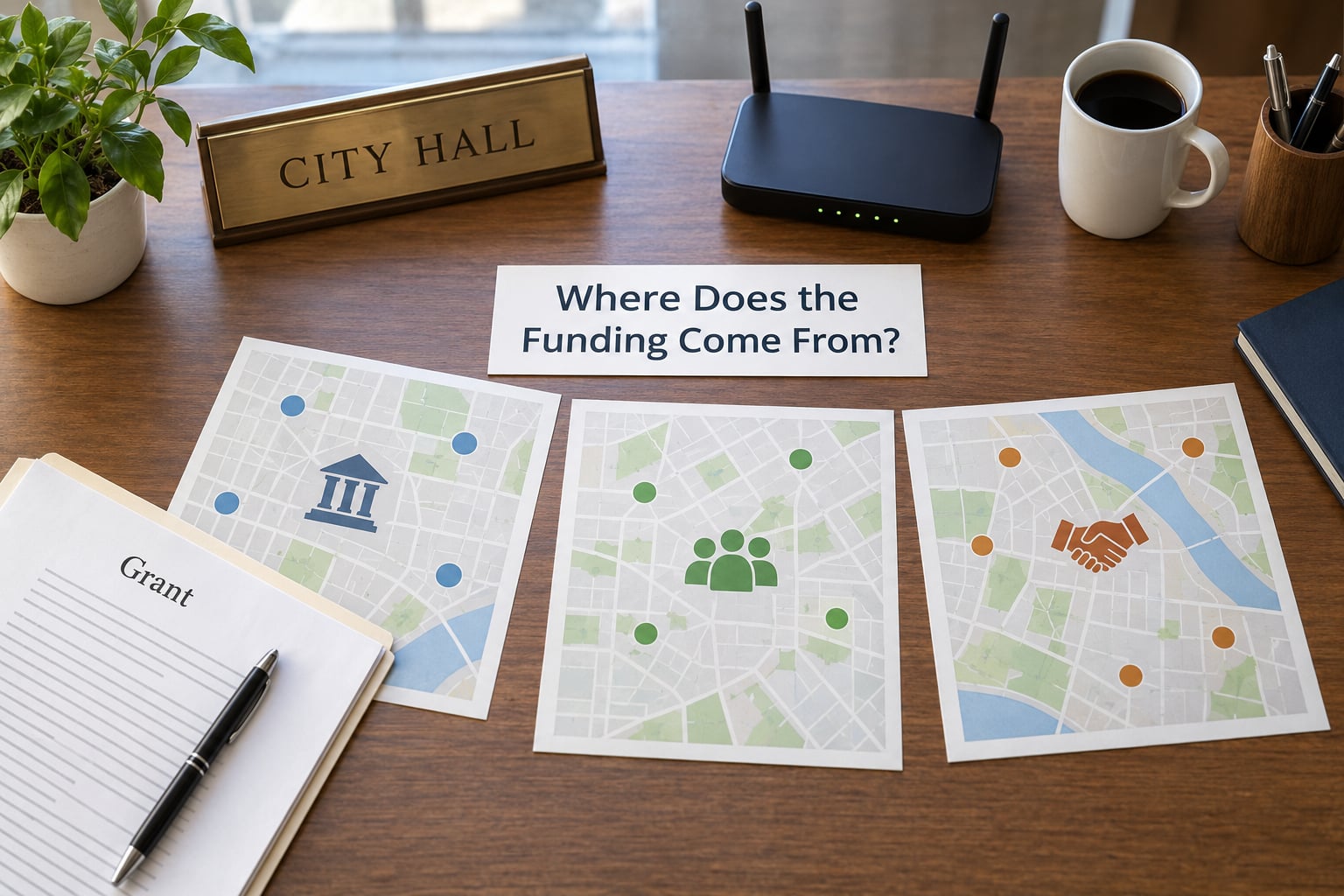
Four funding models show up in practice, and they behave very differently when money gets tight.
- Federal household subsidies fund the credit directly and set national eligibility rules. They are the most portable and the most vulnerable to an appropriation lapse.
- State and municipal programs draw on state general funds, utility settlements, or local revenue. California LifeLine, run by the public utility commission, is the long-running example.
- Provider contributions come out of the provider’s own pricing. These plans tend to survive federal funding changes because they are already priced in.
- Infrastructure funding pays for construction rather than consumption. The Broadband Equity, Access, and Deployment program, run by the National Telecommunications and Information Administration, is the largest current example, with states administering grants to build to unserved and underserved locations.
| Funding source | Typical administrator | What it can support |
|---|---|---|
| Federal household subsidy | Federal program administrator plus a national verifier | A monthly service credit and a one-time device discount |
| State appropriation or utility fund | State broadband office or public utility commission | Monthly credits, plan discounts, and fee waivers |
| Provider contribution | The internet service provider | A permanently discounted rate and free equipment |
| Federal infrastructure grant | State broadband office, then a grant recipient | Network build and upgrades in underserved areas |
| Nonprofit or community network | Community organization or municipality | Shared Wi-Fi, kiosks, and long-term local capacity |
Infrastructure money reaches households indirectly and slowly. A fiber route funded through a state grant might land in your neighborhood, add competition, and change what the local market charges three years later. Nobody sends you a check for it.
How Does the Application and Enrollment Process Work?
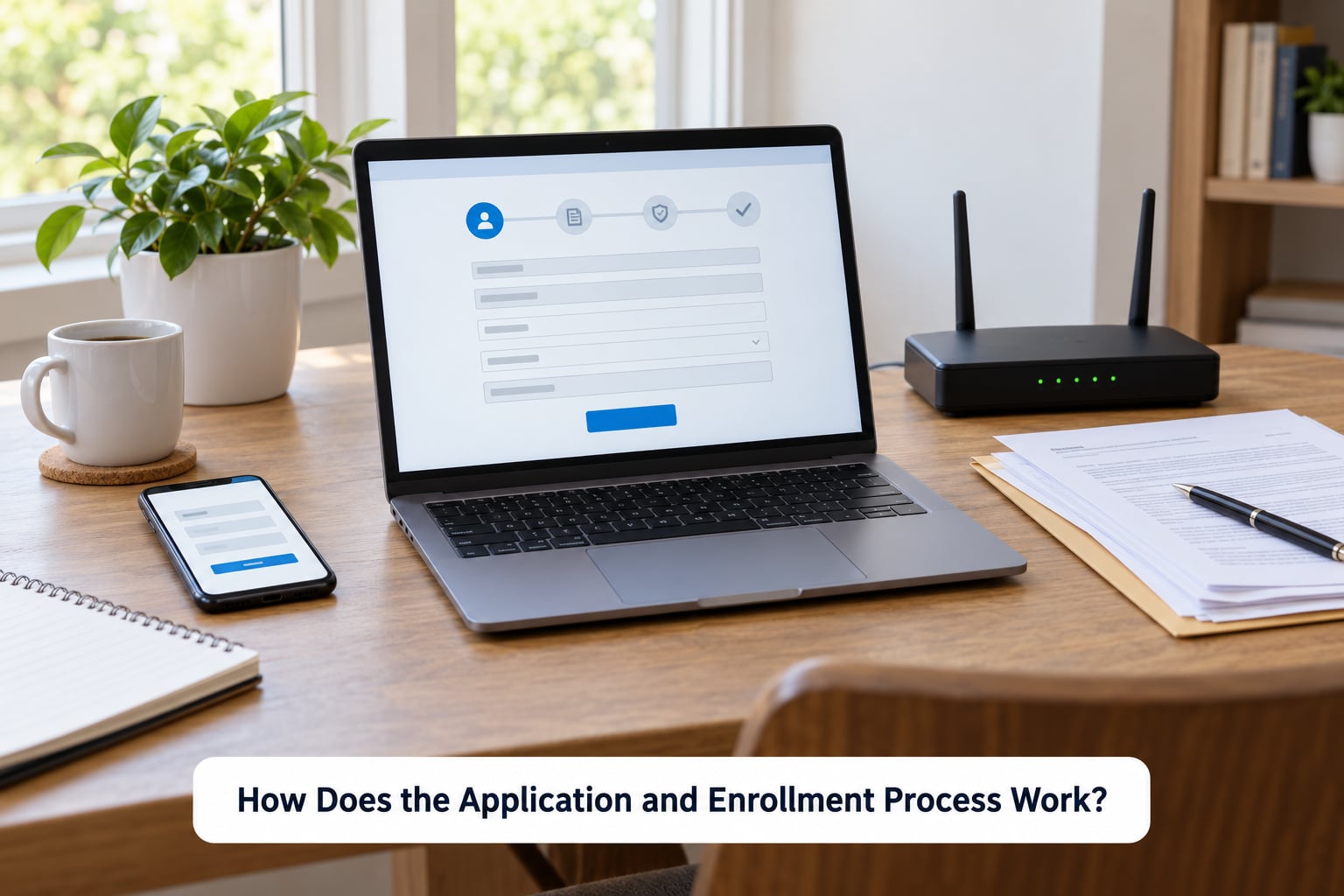
The process is longer than most people expect, and each step has a way to stall.
- Check eligibility first. Run your household size and income against the published threshold before gathering documents. Ten minutes here saves a rejected application.
- Assemble proof. A social security award letter, a benefit statement, or a recent pay stub usually works. Providers accept different documents, so ask yours.
- Submit the application. Federal programs route through a national verifier that validates the result with the source agency. Provider plans are completed on the provider’s own site.
- Choose a qualifying plan. The program lists eligible plans with speeds, prices, and any equipment requirements. Pick from that list.
- Schedule installation or self-install. Self-install kits typically arrive by mail. A technician visit may be scheduled where service has never been active.
- Watch for re-verification. Most programs check eligibility annually. Missing that notice moves you back to full price.
Timeframes range from same-day digital approval to several weeks where a technician visit is required. A household that already has service of the same class usually activates fastest, because the line already exists.
If an application is denied, the most common reasons are an address that does not match your benefit record, an incomplete household definition, and a document that has expired. Fix the specific error and resubmit rather than starting over.
What Should a Household Look for in a Program?
Look at the total monthly cost after the discount, not the discount itself. A program that cuts service substantially but leaves a large equipment charge can cost more than the plan it replaced.
- Speed after discount. Subsidized plans often sit below the fastest tier. Video calls and streaming work fine at moderate speeds, but large uploads and simultaneous household use are where the ceiling shows.
- Data caps. Some discounted plans cap monthly data or throttle heavy use. An uncapped plan is worth more to a heavy-use household than a faster capped one.
- Equipment and installation fees. Check whether the modem or gateway is rented, whether it is provided free, and whether activation is charged.
- Contract terms. Assistance-program pricing is usually month to month. A promotional price that requires a 24-month term is a different product with different risks.
- Renewal rules. Ask what happens when the subsidy ends. Some plans revert to a lower tier, some to full price.
- How long the discount lasts. A permanent provider discount is more durable than a federal appropriation that can run out mid-year.
- Support and upgrade path. Check that the provider serves your exact address and can raise your speed later without a new installation.
One practical habit: keep a copy of your approval notice. When a discount disappears, the fastest way to resolve it is usually showing the provider the date you enrolled and the plan you qualified for.
Why Do Broadband Affordability Programs Matter for Cities?
Connectivity is now a prerequisite for interacting with the city itself. Applications, benefits renewals, utility billing, school communication, telehealth appointments, and most municipal forms happen online. A household without reliable service deals with those systems through a library, a phone call, or a neighbor.
That is why affordability programs show up in city planning documents rather than just consumer guides. Public utility commissions handling affordability cases, libraries acting as application sites, and city-funded public Wi-Fi are all ways local government keeps trying to close the gap.
Municipal broadband takes it further. A city that builds or partners on its own network can set pricing as a policy decision, which some communities have used to undercut commercial rates. Community networks run by cooperatives or nonprofits operate the same way. These models are slow and capital-heavy, and they are usually confined to a few places, but they change the price floor for everyone else in the service area.
Cities also measure these programs wrong more often than they measure them badly. Enrollment counts get reported because they are easy. A program that signs up a thousand households and loses service after six months has not solved much. Reliable connection, sustained at an affordable price, is the measure that means something.
What Challenges Do These Programs Face?
Every one of these programs has a supply problem, a process problem, and a durability problem. The hardest one to fix is usually supply.
- Limited provider choice. In many rural and low-density areas, one provider serves the whole area. A subsidy then buys access, not competition, and the discount depends on a company with no local alternative.
- Low advertised speeds. Discounted tiers often sit well below the top speed a provider sells, because the program price is built around a cheaper base plan.
- Verification friction. Address mismatches and expired documents are the top reasons applications fail, and the households with the least slack are the ones least able to fix them.
- Device costs. Even with service subsidized, households need a router or gateway. A one-time device discount helps, but it is separate paperwork and often a separate deadline.
- Awareness gaps. There is no single national portal after the Affordable Connectivity Program ended. People find out about help from libraries, schools, community organizations, or a neighbor.
- Drop-off after enrollment. Households report services that lapse after a re-verification notice goes unanswered, often because the notice arrived by letter and nobody opened it.
- Funding durability. A program that depends on an annual appropriation can end mid-year, which leaves households to absorb an abrupt price increase.
The pattern people describe in community forums is consistent: households keep the provider and drop the speed, or move to fixed wireless home internet, rather than disconnect. Losing the connection entirely is the outcome most families are trying to avoid, because it takes a job search and a telehealth appointment with it.
Frequently Asked Questions
Do broadband affordability programs require a contract?
Usually not. Federal and state assistance programs price service month to month, and a household can end enrollment without an early termination fee. Watch promotional prices bundled with the program, though, because those often carry a 24-month term and a cancellation charge. Read the plan terms before you enroll rather than assuming the subsidy rules and the contract terms are the same thing.
Can I qualify if I already have internet service?
It depends on the program. Some subsidies require that your household has no home internet service at all, while others let you switch providers or upgrade an existing line and keep the credit. Provider low-income plans frequently accept existing customers. Check the eligibility rules for the specific program, and ask the provider directly, because the answer changes the plan you should pick.
Are discounted plans fast enough for video calls and remote work?
For most households, yes. Video calls, streaming, and schoolwork run comfortably on the mid-tier speeds that subsidized plans typically offer. Problems appear when several people use the connection at once, when large files need to be uploaded, or when the household also relies on the connection for a work VPN. Check the upload speed, not just the download number advertised on the plan.
What documents do I need to apply for a broadband discount?
Usually one document proving either your income or your participation in a qualifying assistance program. A social security award letter, a SNAP or SSI benefit statement, a federal Pell Grant notice, or a recent pay stub commonly works. Programs that verify through a national database may need no documents at all. Ask the program or provider for its accepted list before you start, since each one differs.
Do broadband affordability programs cover routers and installation fees?
Some do, some do not. A one-time device discount for a router or gateway is common in federal programs, and provider low-income plans frequently include the modem at no charge. Installation and activation fees are more often waived only when a promotional period applies. Treat the equipment as its own line item when you compare plans, because a large rental charge can erase a meaningful service discount.
How long does it take to receive service after applying?
Approval itself is usually quick, often the same day for digital applications verified through a national database. Installation is the variable part. Self-install kits arrive by mail and can be running within a few days, while a technician appointment for a household without existing service can take several weeks. If you have current service on the same class, an upgrade usually activates fastest.
Conclusion
Start by confirming eligibility against the program’s own rules, then compare every participating provider on the full monthly cost including equipment and fees. Pick the plan on the approved list, and set a reminder for the re-verification date before you activate service.
For cities and program administrators, the same sequence applies at scale. Publish one clear entry point, track households through to sustained service rather than to enrollment, and treat provider coverage and device cost as program design problems, not household failures. A credit that reaches a bill and stays there is the whole point.