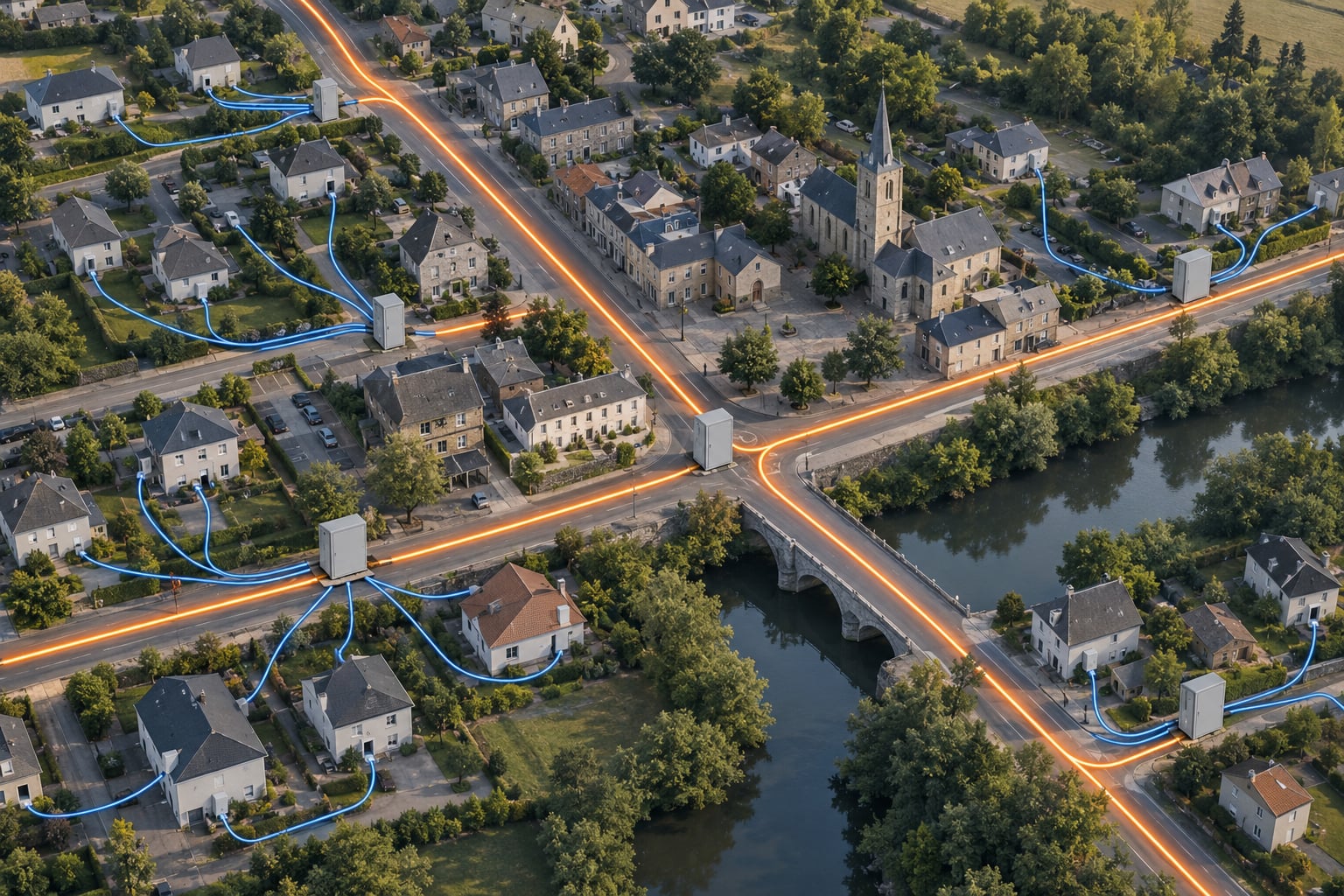
A municipal broadband network is a high-speed internet system a city plans, finances, builds and maintains itself, usually on fiber-optic cable. To see how municipal broadband networks are built, picture a sequence: assess demand, design the routes, raise the money, secure rights-of-way, dig or borrow a pathway, pull and splice fiber, light the core, then connect individual buildings.
Most readers searching this phrase are looking for one of three things. Some are civic staff who inherited a network nobody documented. Some are city officials weighing whether to build at all. A few are developers asking what a tie-in to municipal fiber actually costs and involves. This guide covers the mechanics and the decisions, and it is honest about the projects that stalled.
The word to keep in mind throughout is infrastructure. A city rarely becomes a consumer-facing internet company by default. What it usually builds is a piece of wired infrastructure that one or more service providers then light up for paying customers.
Table of Contents
- What Is a Municipal Broadband Network?
- Public broadband service is not the same as public Wi-Fi
- The four roles behind the network
- Key vocabulary you will hear in every meeting
- How Municipal Broadband Networks Are Built From Start to Finish
- What Does a Municipal Broadband Project Need Before Construction?
- Which Network Design Works Best for a City?
- How Cities Fund and Pay for Broadband Infrastructure
- How the Physical Network Gets Installed
- How Municipal Broadband Networks Reach Homes and Businesses
- How Cities Test, Secure, and Maintain the Network
- Frequently Asked Questions
- Who owns the fiber in a municipal broadband network?
- Is municipal broadband the same as public Wi-Fi?
- Who pays for the construction of a municipal broadband network?
- How long does it take to build a municipal fiber network?
- Do residents have to switch to municipal broadband?
- Where to Begin With a Municipal Broadband Project
What Is a Municipal Broadband Network?
A municipal broadband network is the set of physical assets a local government owns or controls to move internet traffic: fiber cable, conduit, handholes, cabinets, electronics, and the facilities that house them. The city may sell service to residents itself, or it may lease the network to private providers who do the selling.
What separates this from ordinary internet service is who controls the asset underneath. When an incumbent carrier builds a neighborhood, the cable, the cabinets and the customer relationship all belong to that carrier. When a city builds, the conduit stays a public asset, and the customer relationship can be structured several different ways.
Public broadband service is not the same as public Wi-Fi
Plenty of towns already run open Wi-Fi at a park, a library or a downtown square. That is a service on a network, not a network built to reach homes. Public Wi-Fi usually rides over whatever connectivity the city already pays for, and it stops at the edge of that connectivity.
A residential municipal broadband network is a much larger commitment. It is built to pass every structure in a defined service area, with enough capacity and spare fiber to grow for decades. The two can coexist on the same infrastructure, but they are funded and built as separate decisions.
The four roles behind the network
Practitioners coming into this field for the first time usually stumble over the same thing: four parties are involved, and the same organization often plays more than one of the roles.
- Network owner. Holds the conduit, cable and facilities, and carries the capital cost of building them. Frequently the city itself.
- Network operator. Runs the electronics that light the fiber, monitors it and repairs it day to day. This is often a contracted operations firm or the city’s IT department.
- Service provider. Sells internet to customers on the network and handles billing, support and marketing. This may be the city, a co-op, or several competing ISPs sharing one open-access network.
- Consumer. The resident, business or institution taking service, usually under a contract that runs a year or more.
Those role lines are contractual, not physical. Fiber does not care who owns which strand. What decides everything is which entity holds the maintenance obligation when a cut happens at 2 a.m.
Key vocabulary you will hear in every meeting
A few terms carry most of the meaning in a broadband project, and misusing them in a public meeting leads to arguments that are really about something else.
Middle mile is the fiber that runs between a core node and a neighborhood aggregation point, usually along main streets and backhaul routes. Last mile is the stretch from that aggregation point to an individual building. Take rate is the share of passed homes that actually subscribe, and it is the number that decides whether a network survives financially. Make-ready is the work of clearing and preparing an existing utility pole or easement so fiber can be attached. Dark fiber is cable with no light in it; the customer supplies the electronics. An IRU, indefeasible right of use, is a long-term lease of a defined number of fibers that cannot be pulled out from under the leaseholder. Cost per passing is the capital cost divided by the number of homes the build touches, whether or not any of them subscribe.
That last term is where most public debate happens, and where the vocabulary gets fuzzy. A network can show a respectable cost per passing and still be a financial problem if the take rate never arrives.
How Municipal Broadband Networks Are Built From Start to Finish
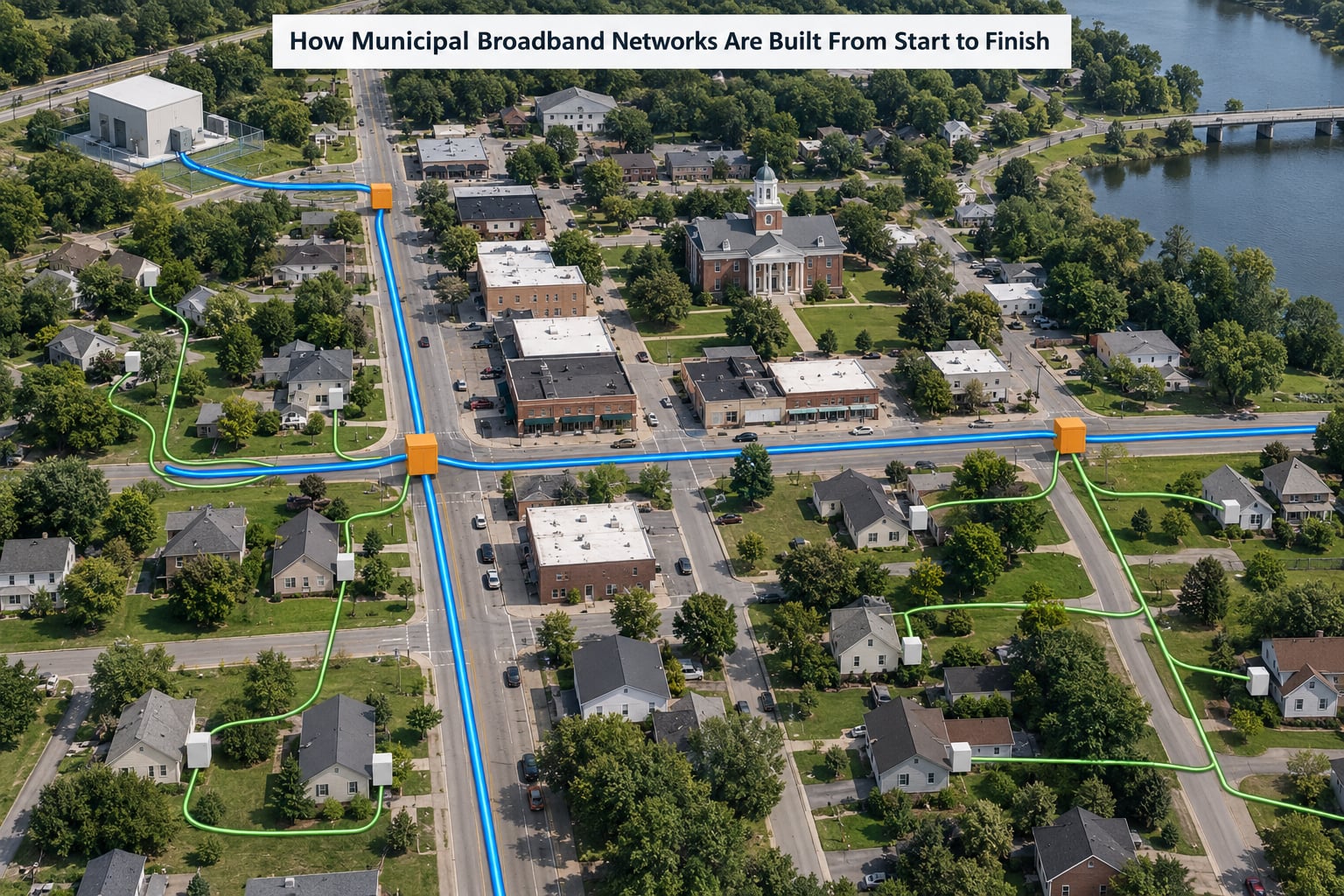
Every city runs the same eight phases, though the order of two and three often overlaps and the whole sequence can take three to five years before the first customers get turned up.
- Needs assessment. Map the service area against existing provider coverage, count households and businesses, and identify institutional customers like schools, a health clinic or a police department. The point is a defensible list of who would actually take service.
- Feasibility study and broadband master plan. An engineering firm models routes, estimates cost per passing, and identifies the constraints that will drive the budget: terrain, density, existing conduit, pole ownership. This is normally the first thing funded, and it is often the only deliverable a stalled project ever produces.
- Governance and financing. The city picks an ownership model, then assembles the capital from grants, bonds, reserves and operating income. Depending on the state, this may require a ballot measure or a council vote.
- Rights-of-way and permitting. Negotiate easements, get street excavation permits, coordinate pole attachments and pay make-ready charges, and schedule joint trenching with any water or gas main work happening in the same streets.
- Network design and engineering. Finalize the fiber count per segment, cabinet locations, electronics at the headend, and the drop plan for each neighborhood. This is the point where the master plan becomes a real bill of materials.
- Construction. Place conduit, pull fiber, build cabinets and splice the runs. Municipal crews usually handle traffic control and handholes while a contracted fiber contractor does the bulk of the pulling and splicing.
- Testing and activation. Test every fiber segment with an OTDR or equivalent, light the middle mile, and commission the electronics before anything is sold to the public.
- Last-mile drops and adoption. Extend fiber into buildings, install customer-premises equipment, and work the take rate up neighborhood by neighborhood. Adoption is the slowest phase and the one that decides the network’s financial health.
Phases six through eight overlap heavily in practice. Contractors often build in passes, lighting a couple of neighborhoods while later routes are still being permitted, so the city can start earning revenue before the last street is finished.
What Does a Municipal Broadband Project Need Before Construction?
The prerequisites are unglamorous and they are where projects stall. A city that skips them tends to discover the gap in month fourteen, when the contractor is standing at a corner with a permit it cannot get.
Service-area mapping. Not just a list of streets, but a parcel-level view of which structures are passed, which are served, and where the density drops off. Overbuilding into low-density areas is how cost per passing climbs.
Demand estimates. Build these from take-rate evidence rather than optimism. A useful test: how many anchor institutional customers will sign a multi-year contract before construction starts, because predictable revenue carries the bond better than projected residential signups.
An existing infrastructure inventory. Catalog every piece of conduit the city or a utility already owns, including abandoned water and gas mains that could host conduit. This inventory is also the answer to a question new municipal IT staff often face, since inherited documentation is frequently incomplete or missing.
Rights-of-way. Street excavation permits, pole attachment agreements, and easements on private property. On a pole already carrying power, phone and cable, the make-ready bill can exceed the fiber installation cost for that segment.
Public engagement. Public meetings, mailers, surveys and a plain-language website. A project approved by council before residents understand the take-rate model tends to face a trust problem during adoption.
Resilience requirements. Diverse fiber paths so a single cut does not take out an entire neighborhood, plus a plan for backup routing. Underground conduit, argued in some of the longest public debates in this field, is primarily a resilience and maintenance-cost decision.
Partner agreements. Where the city is not building alone, agreements with utilities about shared trenches, with an operator about day-to-day duties, and with service providers about who reaches the customer.
Which Network Design Works Best for a City?
There is no single right design, because the right answer depends on density, terrain and how much money the city can put at risk. The real decision is how far the fiber goes before it reaches a customer.
| Design | Coverage | Speed and symmetry | Time to serve | Upgrade path | Best fit |
|---|---|---|---|---|---|
| Fiber to the premises | Every structure in the service area | Gigabit and above, symmetrical upload and download | Longest; every drop is individual work | Effectively unlimited; strand count set at build | Dense towns, anchor-heavy business districts |
| Fiber to the node | Neighborhoods served from shared cabinets | Fast near the node, weaker and less symmetrical at the far end | Moderate | Upgradeable by extending later | Suburban areas with steady demand |
| Fixed wireless | Line-of-sight from a small number of towers | Good download, upload typically far lower than fiber | Shortest; few sites to build | Capacity limited by spectrum and tower count | Rural and terrain-obstructed areas |
| Hybrid fiber and wireless | Fiber where density pays, wireless elsewhere | Two service tiers across one service area | Mixed | Fiber added over time as take rate proves out | Most common real-world municipal answer |
On the question of whether fixed wireless beats fiber, the honest answer is that it depends on density and terrain. Fiber wins decisively on capacity and upload symmetry. Wireless wins on speed to service and on capital needed per square mile in sparse areas. Most municipal builds end up hybrid, and calling that a compromise undersells it: it is the design that matches spending to demonstrated demand.
One design decision deserves more thought than it usually gets, and that is strand count. Fiber is cheap to pull and expensive to add later, so a core route built with a modest strand count becomes a bottleneck within a few years.
How Cities Fund and Pay for Broadband Infrastructure
Capital comes from more than one source, and the mix usually decides whether a project is feasible. Federal and state grant programs help, but they rarely cover a full build on their own.
Current federal programs to know about include BEAD, the Broadband Equity, Access and Deployment program administered through state broadband offices, and earlier programs like RDOF and the Universal Service Fund. These are competitive, application-driven, and often require a build commitment on a fixed schedule, which can pressure a city into committing before its design is finished.
Below the grant layer sit the instruments a city actually issues: general obligation bonds, revenue bonds backed by the network’s own income, state loan programs, and cash reserves. Vendor-financed and IRU structures exist too, where a partner builds and holds long-term fiber rights in exchange for future payments.
| Model | Capital source | Who controls service | Speed to service | Revenue risk sits with | Best fit |
|---|---|---|---|---|---|
| Municipal utility | Bonds, grants, reserves, operating income | The city, end to end | Slow; full staff and contracts needed | The city | Communities with density and stable demand |
| Open access | Same as above | City owns the wire, any ISP may sell on it | Moderate | Shared; the city carries the asset risk | Towns wanting several providers without several networks |
| Public-private partnership | Private equity plus public grants or in-kind assets | The partner, under contract | Fastest | The partner, then the city at contract end | Smaller cities without staff or bonding capacity |
| Wholesale dark fiber lease | City or utility builds, leases capacity | The lessee | Fast | The lessee | Underserved areas where a provider already exists |
None of these is the cheapest option in a vacuum, and claims to the contrary deserve suspicion. A partnership moves the capital off the city’s balance sheet and shifts day-to-day operation to someone who does it for a living, and in exchange the city gives up control and pays for the privilege over twenty years. A municipal utility keeps the upside and the downside.
Two funding terms recur in every serious analysis. Cost per passing is the number the press quotes. Take rate is the number that decides whether the debt gets repaid. A build can look affordable on the first number and still be unaffordable once subscribers fail to arrive.
How the Physical Network Gets Installed
This is the part of the process that residents notice and that most written explanations skip. Conduit goes in first, then cable, then the cable is spliced and tested.
| Method | How it works | Where it fits | Watch out for |
|---|---|---|---|
| Open-cut trenching | Dig a trench, lay conduit, backfill and restore | Dense urban streets with predictable routes | Most expensive per foot and the most disruptive to pavement and traffic |
| Directional drilling | A steerable drill bores under streets and obstructions | Crossings, railroads, and anywhere excavation is barred | Locating existing utilities has to be exact, and mistakes are invisible until they fail |
| Microtrenching | A narrow saw cut a few inches deep, conduit dropped in, surface sealed | Sidewalk and parking-lane restoration in developed areas | Shallow depth means more make-ready conflicts later |
| Aerial strand | Figure-eight or lashed cable on existing utility poles | Rural routes, alleys, fast rural builds | Make-ready cost and tree trimming, plus more weather exposure than buried plant |
| Reusing existing mains | Abandoned water or gas mains emptied and used as a duct | Streets with dead mains already in place | Requires mains large enough to work in and close coordination with the water or gas utility |
Utility coordination is where cities save real money, and the move is simple: build fiber in the same trench as scheduled water or gas main replacement rather than returning a month later for a second excavation. The negotiation is straightforward in principle and slow in practice, since it means the broadband schedule follows the water department’s capital plan.
The other cost lever is conduit count. Pulling a second cable into an empty conduit later costs a fraction of reopening the street, so designs that seem generous with empty ducts at build time usually pay for themselves within one upgrade cycle.
Splicing is the part nobody sees and everybody pays for. Each fusion splice is a permanent joint in the fiber path, and the crews that close them out work method by method along the route, testing as they go so a bad joint is found while the crew is still near it.
How Municipal Broadband Networks Reach Homes and Businesses
Three layers do the work. The backbone links the headend to aggregation points and carries traffic between them. Distribution runs from each aggregation point out along neighborhood routes. Access is the final segment into the building.
The distinction practitioners need most is between a network that passes a building and one that serves it. Passing means the conduit and fiber run by the property. Serving means the fiber actually enters the building, a demarcation point is installed, the inside wiring works, and a customer can subscribe. Those are different costs, and reporting often conflates them, which is how a build gets described as complete when a third of it still needs drops.
Inside the building, the owner or the network provides an optical network terminal, a router, and enough inside wiring to reach each unit. Multi-dwelling buildings and schools are the usual sticking points, since riser space, riser cable ownership and a landlord decision can add months to what looks like a single drop.
When a private business asks to tie into municipal fiber, the request can mean two very different things, and clarifying which one is the whole conversation. Either the business wants a lease on unused strands and supplies its own equipment at both ends, or it wants to buy connectivity over the city’s existing internet connection. The first is a capacity and IRU negotiation. The second is a service contract.
A short checklist for anyone making that request: identify whether the need is transport or internet service, confirm the location sits inside the lit middle mile, ask what spare fiber and strand count exist on that specific segment, and get the city’s interconnection policy and standard agreement in writing before scoping equipment. People who have worked on municipal networks report the documentation is often the missing piece, and asking for the as-built drawings, splice records and cabinet assignments early saves months of guessing.
How Cities Test, Secure, and Maintain the Network
Commissioning happens before any customer connects. Every fiber segment gets tested for loss and reflectance, electronics get commissioned, and speed and latency get measured end to end against what the network is designed to deliver. A network that has not been tested is not finished.
Security planning is part of design rather than a later addition. Network monitoring, access control on the electronics, and physical protection of handholes and cabinets all belong in the original design documents. A handhole that is not locked is a documented example of a network that assumes good intentions at every access point.
Ongoing operations cover monitoring for outages, dispatching a repair crew, carrying spare capacity for growth, replacing failed electronics, and handling the paperwork that makes the asset manageable a decade later. A city that outsources operation still has to own asset management, because that is the part contractors rarely maintain well.
Planning for future demand belongs on the same list. Networks built with thin strand counts and single fiber routes run into capacity limits that are expensive and disruptive to fix, and cities that plan for them early treat spare capacity as insurance rather than waste.
It is also worth saying plainly what can go wrong, because a critical view of municipal broadband ranks on the first page of results and deserves a straight answer. The recurring failure modes are a take rate that never reaches the level in the financial model, a bond repayment that strains city finances, a vendor that defaults mid-build and leaves an unfinished network, and a project that stalls at the feasibility stage and produces a report instead of a service. These are real, and a city that models them honestly with staged builds and conservative demand is doing better than one that assumes everything works.
Frequently Asked Questions
Who owns the fiber in a municipal broadband network?
Usually the city or the entity that financed the build holds the conduit and cable, while a separate operator maintains the electronics and one or more ISPs sell service to customers. The four roles can be collapsed into one city, split across four contractors, or arranged any other way, as long as the contracts say who repairs a cut fiber and who answers a customer. Ask for the as-built drawings and the ownership schedule, which is the document that settles disputes.
Is municipal broadband the same as public Wi-Fi?
No. Public Wi-Fi is a service offered at specific public places over whatever connectivity the city already pays for. A municipal broadband network is infrastructure built to pass and serve homes, businesses and institutions across a defined service area. They can share the same fiber, but they are separate decisions with separate budgets, and a town running free Wi-Fi at the library has not started building a residential network.
Who pays for the construction of a municipal broadband network?
It depends on the ownership model. A municipal utility raises capital through bonds, grants, reserves and operating income, which puts the cost and the risk on the city. A public-private partnership has the partner fund the build and recover costs over a long contract. A wholesale model has the city build and lease dark fiber to a provider. Grant programs such as BEAD and state broadband funds usually contribute a portion rather than the full amount.
How long does it take to build a municipal fiber network?
Budget three to five years from needs assessment to first customers turned up in a typical city, and longer in places with difficult terrain, heavy make-ready work or extensive permitting. Construction itself is often the fastest phase, since crews can move quickly once rights-of-way and permits are in hand. The slow phases are feasibility, financing approvals and adoption, and the last one is where many timelines slip after the network is already lit.
Do residents have to switch to municipal broadband?
No. A municipal network is an option alongside existing providers unless a city has some kind of exclusive arrangement, which is uncommon and often legally restricted. Some residents keep an incumbent because they value specific services, and some neighborhoods with poor take rate end up with a network that passes their street but carries few customers. A build that depends on every household switching is a build that was not planned conservatively.
Where to Begin With a Municipal Broadband Project
If you are starting from nothing, the first move is a broadband master plan funded on its own, with no construction attached to it. Everything after that follows from it.
- Define the service goals in writing. Coverage, speed, price tiers and which institutions must be connected. This is what later decisions get measured against.
- Map the service area and the existing infrastructure. Structures, density, current provider coverage, and every piece of conduit the city or a utility already owns.
- Test feasibility and cost per passing. Have an engineer model the routes before committing to a design or a vote.
- Compare ownership models honestly. Municipal utility, open access, partnership and wholesale lease, scored on capital, control, speed to service and risk.
- Ask residents what they would actually pay for. Survey results that say the take rate will be lower than the model assumes are worth more than a favorable presentation.
- Build the operating plan before breaking ground. Staffing, maintenance contracts, spare capacity, the adoption plan and the affordability program set aside from revenue.
Written for 2026, and worth re-reading as grant rules and state law change. A network that reaches homes, schools, clinics and a few smart city sensors ends up doing far more than the speed test on a residential package suggests, which is the quiet argument for building this kind of infrastructure at all.